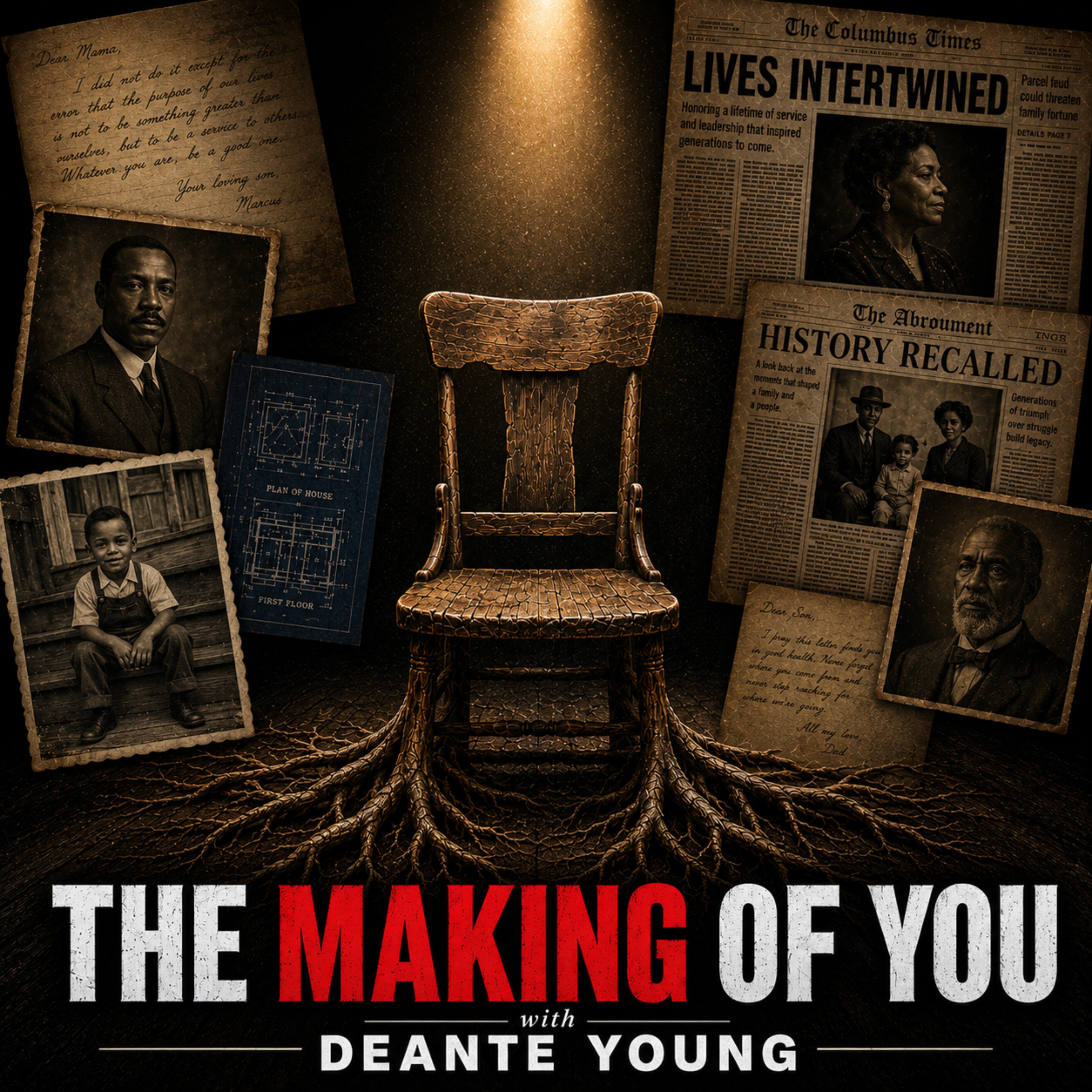
- The Making of You with Deante Young S2 E3 (Still Standing)
In this episode of The Making of You with Deante Young, Deante sits down with legendary investigative reporter Carl Monday to uncover the family, faith, relationships, tragedies and chance encounters that formed the man Cleveland came to know for confronting people no one else wanted to confront.
Long before the trench coat, the I-Team and nearly five decades of investigative journalism, Carl was Carl Stalinsky, a kid growing up in Cleveland’s Slavic Village in a deeply Catholic Polish-American family.
He was an altar boy at St. Stanislaus, sometimes attending church more than a dozen times in a week. His parents taught him that some things were simply right and some were wrong—a moral distinction Carl believes followed him directly into the work he eventually chose.
His family also carried extraordinary hardship.
Carl’s father had served on the front lines during World War II, returned home carrying shrapnel, left school early to help support his family and worked multiple jobs. Before Carl was born, his father accidentally struck and killed two women during a snowstorm, was convicted of vehicular manslaughter and spent years dealing with the financial and emotional consequences.
Carl watched a father who continued working and providing anyway.
From his mother, he inherited something different.
She could talk to anyone. She was kind and gentle, but Carl remembers that she could also be a fighter when her children needed one. Carl believes much of his own ability to communicate came from her.
Then history changed his direction.
Carl entered Kent State interested largely in music and radio. But in May 1970, he witnessed the upheaval surrounding the Kent State shootings. Seeing a national tragedy happen in his own backyard changed the way he saw news and ultimately helped redirect his life toward journalism.
From there came a succession of people who helped build him.
College friend Greg Benedetti pushed him to get serious about news instead of entertainment. Mike Drexler gave him an almost unbelievable on-the-spot audition at WERE and put him on the air minutes later. That station’s aggressive “People Power” approach helped Carl develop the confrontational reporting style that would eventually define him. And legendary news director Virgil Dominic heard Carl’s work on the radio, took a chance on him and brought him into television.
Carl would spend 22 years at what became Fox 8.
Along the way came hundreds of confrontations, lawsuits, surveillance operations and stories that became part of Cleveland television history—including the infamous showdown with George Forbes over an unpaid water bill.
But there was a cost to doing that work.
Carl says he still experiences what he calls “TV PTSD,” including nightmares about confrontations and being chased. One investigation became so dangerous that two police departments warned him there was a hit on his life, the FBI monitored his home and Carl lived with security for months.
Behind the reporter was also a husband and father.
Carl and his wife Sandy have spent more than five decades together, through the intensity of television journalism and losses that no career could prepare them for.
In 2022, Carl and Sandy lost their only daughter, Melissa. Carl says losing a child is something a parent never truly gets over. And when his mother died years earlier, he described her simply as “everything to me.”
That is what makes this conversation about much more than famous investigations.
It is about where toughness comes from, what a lifetime of confronting wrongdoing does to a person, who gives us permission to become who we become, and what remains when the cameras finally turn off.
Carl estimates he was involved in thousands of stories during his career.
But when asked what he wants his enduring legacy to be, he doesn’t mention the awards, the mustache, the trench coat, or even his own name.
He hopes the work did some good for the people who trusted him to help safeguard their community.
🎙️ Watch more episodes of The Making of You with Deante Young:
https://www.youtube.com/playlist?list=PLEpgmvTsuQJw
✅ Connect with Carl Monday:
https://www.facebook.com/carlmondayinvestigations
✅ Follow Deante Young:
LINKEDIN: http://www.linkedin.com/in/deanteyoung
INSTAGRAM: http://www.instagram.com/deanteunlimited
FACEBOOK: http://www.facebook.com/authordeante
🧬 Take The Historical IP Challenge:
Which part of your history could help someone?
http://www.historicalip.com
📖 Learn more about Deante Young: http://www.deanteyoung.com
🔔 Subscribe to https://www.youtube.com/playlist?list=PLUPlYx9LOQhQ for conversations that go beyond what extraordinary people accomplished to uncover the relationships, experiences, struggles, and turning points that made them who they became.
S2E3 - 1h 41m - Oct 13, 2026 - The Making of You with Deante Young S2 E2 (Help, Advance, and Advocate)
In this episode of The Making of You with Deante Young, Deante sits down with entrepreneur, investor, and longtime economic-development leader Ray Leach to uncover the relationships, losses, and experiences that shaped how he came to see business, community, and his responsibility to other people.
Long before Ray became the founding CEO of JumpStart or co-founder and president of The O.H.I.O Fund, he grew up in a family shaped by business, faith, optimism, and strong relationships.
Then Ray lost his father at seven years old.
His mother returned to work, his older brother took on greater responsibility, and Ray grew up with a gap he says never completely disappears after losing a parent that young. Around the same time, he was already showing entrepreneurial instincts—including selling popcorn at school at about eight years old.
Ray also began doing something revealing: looking for men.
He sought relationships with friends’ fathers and other older men who could provide some of what he had lost. One of the most important was Denny Whalen, who became a father figure during Ray’s teenage years and later gave him one of his earliest professional experiences.
Ray also carried an unusual level of confidence that he still can't completely explain. Looking back at himself at 12, 14, and 16, he remains surprised by his willingness to try things despite the absence he carried. When other kids came at him negatively, his instinct was often to understand rather than retaliate:
“Never assume anything. You don’t know what somebody is carrying.”
But some of Ray’s formation happened much later.
He speaks candidly about growing up largely inside a white world and realizing there were experiences in America he did not understand. His work at JumpStart brought him into deeper relationships across Cleveland, and criticism pushed him to listen, study, and become more intentional about race, inequality, and the communities he was trying to serve.
Ray says he learned to embrace some of that criticism because “I didn’t know what I didn’t know.” His work with community leaders and President Barack Obama’s National Advisory Council for Innovation and Entrepreneurship expanded his understanding of what helping a community could require.
His business journey was equally unpredictable.
After beginning his career at IBM, Ray left at 22 to start a company with longtime friend Keith Stewart. Years later, he attended MIT, hoping to move into venture capital—only to encounter the dot-com collapse, Enron, and the aftermath of September 11.
That disruption brought him back to Northeast Ohio.
Ray thought he might spend a year or two helping build JumpStart.
He stayed for 20 years.
Over time, the work became what Ray describes as a ministry—using knowledge, capital, relationships and resources to help entrepreneurs pursue what they were trying to build.
Behind much of that work was his wife, Jennifer, whom Ray calls his confidant. He says she understands him better than he understands himself and gave him the confidence and mental stamina to lead JumpStart.
Ray also identifies relationships that changed his direction—including Denny Whalen, Keith Stewart, Dorothy Baunach, David Morgenthaler and Mark Kvamme.
Today, through The O.H.I.O Fund, Ray is pursuing what he calls “the most ambitious thing I’ve ever been part of”—another chapter built around relationships, entrepreneurship, and Ohio’s economic potential.
But this conversation is about more than entrepreneurship, investing or economic development.
It is about what happens when loss creates a gap, other people step into it, confidence arrives before evidence, and experience forces you to reconsider what you thought you understood about others.
Because Ray’s story keeps returning to one idea:
Everything is about people and relationships.
🎙️ Watch more episodes of The Making of You with Deante Young:
https://www.youtube.com/playlist?list=PLEpgmvTsuQJw
✅ Connect with Ray Leach / The O.H.I.O Fund: https://theohiofund.com/
Connect with Ray Leach on LINKEDIN: https://www.linkedin.com/in/raytleach/
✅ Follow Deante Young:
LINKEDIN: http://www.linkedin.com/in/deanteyoung
INSTAGRAM: http://www.instagram.com/deanteunlimited
FACEBOOK: http://www.facebook.com/authordeante
🧬 Take The Historical IP Challenge: Which part of your history could help someone?
http://www.historicalip.com
📖 Learn more about Deante Young: http://www.deanteyoung.com
🔔 Subscribe to https://www.youtube.com/playlist?list=PLEpgmvTsuQJw for conversations that go beyond what extraordinary people accomplished to uncover the relationships, experiences, and turning points that made them who they became.
S2E2 - 1h 44m - Oct 6, 2026 - The Making of You with Deante Young S2 E1 (Find the End of the Line and Get in It)
In this episode of The Making of You with Deante Young, Deante sits down with Dr. Yvonne Pointer to uncover the experiences, relationships and convictions that formed a woman whose life became defined by faith, service and an unwillingness to quit.
Yvonne grew up as one of ten children in Cleveland, surrounded by family traditions, neighborhood accountability and parents whose words stayed with her for decades.
Her mother taught her that there was good in everybody. Her father taught his children to work, take responsibility and pay their bills. But some of the words Yvonne heard as a child also created insecurities she admits she still has to fight today.
As a young girl, she was an avid reader who imagined a world far beyond her neighborhood. She became fascinated by figures such as Harriet Tubman and Dr. Martin Luther King Jr., eventually seeing in them something that would become central to her own life: when something is wrong, waiting for somebody else to fix it may not be enough.
But Yvonne’s own path was far from straight.
Despite loving school, she says she began diminishing herself in order to be accepted by other teenagers. She started cutting class, drinking, smoking marijuana and doing things she admits she never really wanted to do.
At 16, she became pregnant with her daughter Gloria and was removed from traditional high school, eventually continuing her education through an adult education program while her parents helped her raise her child.
Then came December 6, 1984.
Fourteen-year-old Gloria left home for school, where she was supposed to receive a perfect-attendance award. She never arrived. Later that morning, Yvonne learned that her daughter had been raped and murdered.
What followed was not simply grief. Yvonne began to see what happened to Gloria as an injustice, and that distinction changed the direction of her life.
In this conversation, Yvonne explains how pain became purpose, why she believes tragedy can become ministry, and how she eventually realized that the people waiting for someone to come solve the problem may themselves be the answer.
That belief led to decades of advocacy, the creation of Positive Plus, violence-prevention work, service to families and children, work in Ghana and a life increasingly centered on helping people move through circumstances that could otherwise consume them.
She also reveals the people who helped build her along the way, including Harriet Tubman, Margot Copeland, Dr. Gwendolyn Goldsby Grant and Cleveland Councilwoman Fannie Lewis. It was Lewis who gave Yvonne a
piece of advice that became one of the defining lessons of her life:
“Find the end of the line and get in it.”
Instead of waiting for someone to hand her an opportunity to serve, Yvonne began volunteering, showing up and helping wherever she could. Little by little, she says she moved from standing outside the room to eventually being seated at the table.
The episode also reaches one of the most extraordinary intersections of Yvonne’s life. When Amanda Berry, Gina DeJesus and Michelle Knight were rescued in Cleveland in 2013, Yvonne was asked to sit beside Knight because no family member was there to receive her.
Holding her hand, Yvonne thought about what she would have given for someone to have been beside Gloria in her final moments. The two women eventually began singing “Lift Every Voice and Sing” together in the hospital.
Then, after 29 years of searching, Yvonne finally came face-to-face with the man who murdered her daughter.
She did not go to death row seeking revenge.
She went hoping to understand what might prevent another child from suffering the same fate—and to tell him she forgave him. Yvonne explains why holding onto hatred would only continue diminishing her own life: he had already taken enough from her.
This episode is about far more than surviving tragedy.
It is about the words that stay with us, the people who redirect us, the pain that can become purpose, the faith required to keep moving and the decision to use what happened to you in service of somebody else.
And when asked what she wants her enduring legacy to be, Yvonne’s answer is simple:
She did not quit.
S2E1 - 1h 11m - Sep 29, 2026 - The Making of You with Deante Young S1 E6 (Built From Pain)
SEASON ONE FINALE: In this deeply personal episode, Deante Young sits down with his wife, entrepreneur and author Billie Jo Young, to uncover the experiences that shaped the woman she became.
Billie Jo reflects on growing up poor in Cleveland, the grandmother who taught her strength and independence, and the father who showed her unconditional love despite not being her biological parent.
She speaks candidly about childhood trauma, abusive relationships, anxiety, low self-worth, caregiving, and the people who helped her recognize her own value.
Along the way, Billie Jo reveals how those difficult experiences ultimately reshaped the way she loves, serves others, and approaches family.
It is a raw conversation about pain, growth, forgiveness, self-love, and turning one chapter of your life into wisdom for generations that follow.
S1E6 - 1h 14m - Aug 18, 2026 - The Making of You with Deante Young S1 E5 (Make Your Own Way)
Deante Young sits down with Greater Cleveland Film Commission President Bill Garvey to uncover the unlikely journey that took him from a movie-loving kid in Queens to helping build Northeast Ohio into a serious filmmaking destination.
Garvey shares how a college filmmaking class changed his direction, why mentors and relationships became critical to his rise, and how experiences on The Sopranos, Law & Order, Shutter Island, and other major productions shaped his approach to leadership.
The conversation explores perseverance, work ethic, mentorship, opportunity, and Garvey’s belief that aspiring filmmakers must “make your own way.”
Today, his vision extends far beyond movies: he wants Cleveland to become a filmmaking mecca where tens of thousands of people can build sustainable careers.
S1E5 - 56m - Aug 11, 2026 - The Making of You with Deante Young S1 E4 (God is Good)
In this powerful conversation, Deante Young sits down with civil rights icon Rev. Dr. Otis Moss Jr. to explore the formative experiences that shaped one of America's most influential pastors and activists.
From losing both parents as a teenager and growing up in segregated Georgia to marching alongside Dr. Martin Luther King Jr., Moss shares how faith, family, community, and purpose sustained him through unimaginable hardship.
Together, they discuss the lasting impact of Jim Crow, the Civil Rights Movement, Brown v. Board of Education, mentorship, legacy, and why the greatest inheritance we leave is not our accomplishments, but the values, dignity, and hope we pass to future generations.
A moving conversation about resilience, calling, and the enduring power of formation.
S1E4 - 1h 12m - Aug 4, 2026 - The Making of You with Deante Young S1 E3 (Surviving Hitler as a Child)
What shapes a life after surviving one of history's darkest chapters? In this unforgettable episode, Deante Young sits down with Holocaust survivor Erika Gold, who recounts her childhood in Nazi-occupied Hungary, the loss of dozens of family members, and the extraordinary moments that led to her survival.
More than a story of tragedy, this is a conversation about resilience, family, purpose, and choosing hope over bitterness.
From escaping the Holocaust to building a loving family, a career in medicine, and spending nearly three decades educating future generations, Erika reminds us that our past doesn't have to define our future—it can become our greatest contribution to others.
S1E3 - 1h 4m - Jul 28, 2026 - The Making of You with Deante Young S1 E2 (Be Careful Who You Listen To)
Deante Young sits down with veteran broadcaster, former Woodmere mayor, and Emmy Award-winning journalist Ben Holbert for a powerful conversation about resilience, race, and refusing to let other people define your future.
From growing up in Cleveland during the Civil Rights era to overcoming racism, bullying, and discouraging voices that underestimated his potential, Ben shares the defining moments that shaped his life and career.
Along the way, he reveals the mentors, family values, and hard-earned lessons that carried him from an inner-city childhood to a lifetime of public service and journalism. This episode is a reminder that the voices you choose to believe can shape the rest of your life.
S1E2 - 1h 30m - Jul 21, 2026 - The Making of You with Deante Young, S1 E1 (Standing in the Gap)
What truly shapes a leader? In the debut episode of The Making of You, Deante Young sits down with Cuyahoga County Public Library CEO Jamar Rahming to uncover the defining moments behind his remarkable journey.
From an inner-city childhood in Denver and the wisdom of grandparents who stood in the gap, to a life-changing encounter with Josephine Baker's story, this conversation reveals how ordinary experiences create extraordinary lives.
Together, they explore faith, mentorship, purpose, leadership, and why our greatest legacy isn't our accomplishments—it's the people we influence along the way. This isn't an interview about success. It's a conversation about the experiences that make success possible.
S1E1 - 48m - Jul 14, 2026 - The Making of You with Deante Young (Teaser Trailer)
The official teaser trailer for The Making of You with Deante Young, which features clips of interviews with Jamar Rahming, Ben Holbert, Otis Moss Jr., and Bill Garvey.
0m - Jul 8, 2026