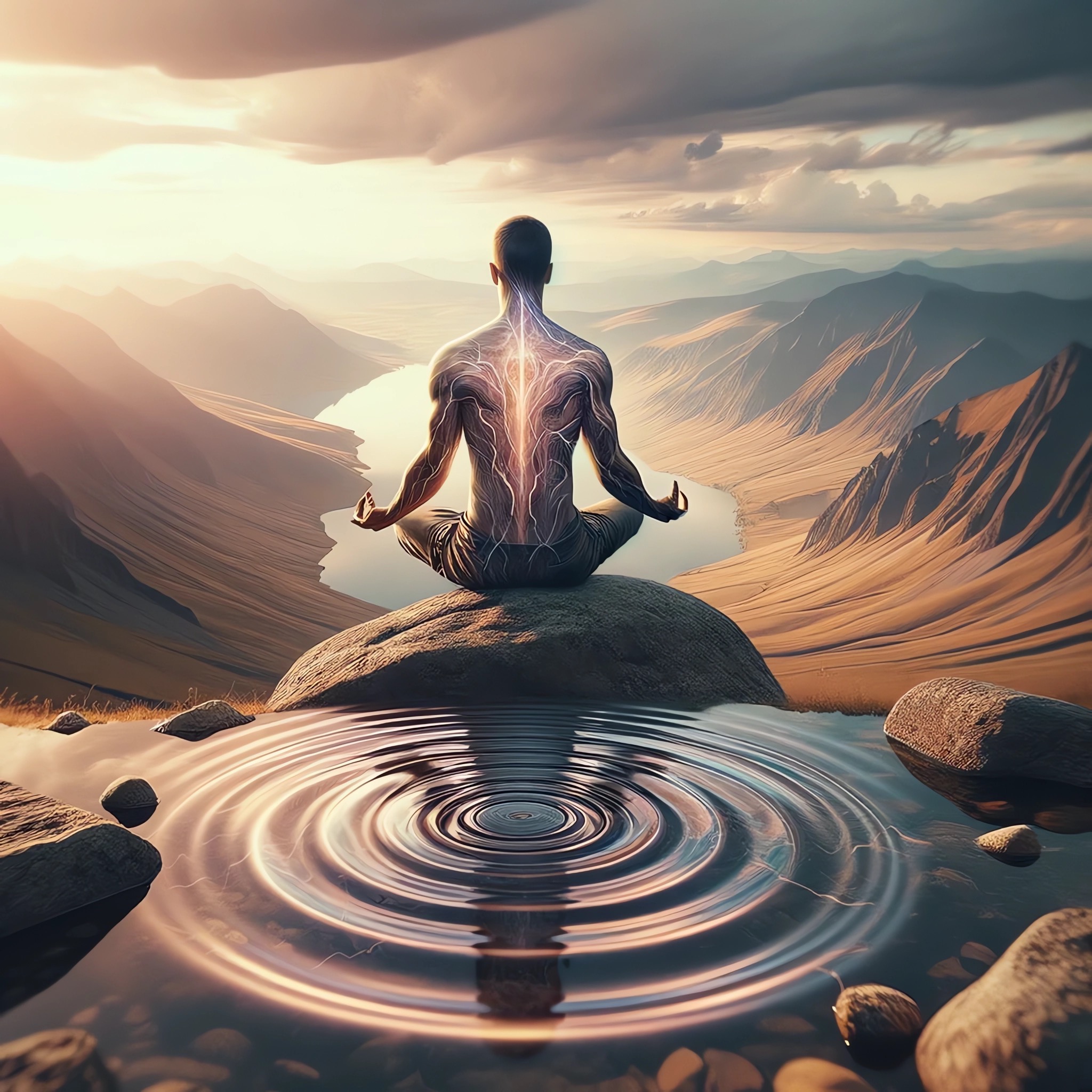
- Jhana Retreat Breathing with the Energy Body (Guided Meditation)
Transcription
In the second one, now we'll go to an energy body, whole body one. We'll do it as a guided meditation, just to give you a few ideas of what you can play with.
[00:49, guided meditation begins]
Okay. Remember, take that time to play with your posture. Sometimes when you're still getting used to all this, and working with the energy body towards samādhi, even micro-adjustments in the posture make quite a big difference, much more than you would think. I could say something about that. Maybe I'll say it on another occasion. Take your time with the posture. Just touching base with the sensations of contact, the feet or the legs, back or the backside on the chair, cushion, bench -- whatever it is.
Feeling, sensing your posture. Sensing the uprightness, the alertness expressed in the posture. Sensing the resolve expressed in the posture. And at the same time, sensing, feeling, throughout the whole body space, the openness, the receptivity, the softness expressed in the posture. This ideal poise of the citta manifesting, expressing in the posture. The citta will shape the posture. The posture, to a certain extent, at least, will shape the citta -- mutual dependent arising.
And the whole-body awareness. Really, again, spreading that attention over the whole space of the body, and even a little bit larger. Now, this attention will shrink so many times you can't count in one session. Not a problem. You just notice that. You open it up again. You fill that space with bright presence, alive sensitivity.
And here, working directly with the energy body, what we're interested in within that space is the texture of it, the vibration, the tone of it, the feel, the energy of it. It shrinks; you keep coming back to that.
When you feel ready, just allowing, supporting, encouraging the breath to be the longest possible comfortable breath. So really not a strain; just as long as is still comfortable -- which may be much longer than you think, or that you're used to. And really not a lot of air. It's really quite a gentle, subtle breath, relatively speaking. A long, slow, smooth breath, in and out. And alive to the whole body space, the whole energy body.
As we explored briefly yesterday, you can tune in, if you like, to the sense of the whole space, the whole energy body expanding and contracting, and what that feels like throughout the whole space. And/or you could also pay attention, tune into, feel into the sense of the whole space being energized, feeling energized with the in-breath, and a kind of relaxation or letting go with the out-breath. Throughout the whole space, these are the energies, qualities, feelings, tones, vibrations, if you like, that you're tuning into, opening to.
And really let that long breath open up the body, open up the whole space. And again and again, opening up the attention, the awareness, to the whole space. Make sure your legs are breathing, are being breathed, your feet. You may not have anatomical images of feet, or legs, or head, or whatever. That's fine. Just let that go, if they're not there, and you don't need to bring them back, or you may. But really the whole body is breathing. The whole body space is involved. Including the head, or where the head is, where the feet are, where the legs are -- that region of the space, region of energy, region of vibration.
Okay. I'm going to do something a little bit different. We're going to take a little bit of a tour. So when you're ready, can you imagine the breath coming into the body, coming into the energy body space, at a point, let's say, a couple of inches to the side, or maybe a little bit below, as well, the navel, the belly button? It's probably not that helpful to imagine the breath as a kind of vapour like you see on a cold day when you breathe out, and the sort of water vapour and air, and that sort of swirling gas thing. Just what we're really interested in is, if I conceive of the breath coming in there, and just imagine that, how does it affect the whole energy, the whole space, the whole tone of the whole body? If you are visual, and you want to experiment with a visual thing, you could imagine the breath as a kind of column of light or beam of light coming in there, into the energy body. And how does it affect, how does it ripple out from there? What do you notice when you imagine that? Whole-body awareness.
But now, we don't have to be wedded to the longest breath. So there are two things to play with here: what do you notice when you imagine the breath coming in there? And also, what kind of breath does the body want coming in there? Is it a really long breath? Is it a much shorter breath? Somewhere in between? Is it a kind of fuller breath, or a very gentle, soothing breath? Don't be afraid to use your imagination to play. What do you notice in the whole body space, and what kind of breath just feels best? All very light, very playful. What do you notice in the whole space -- its energy, its tones, its feeling? And what kind of breath feels best there?
When you're ready, leaving that point there, and imagining the breath coming in at a similar point on the right-hand side. So about two inches from the navel -- doesn't have to be exact at all; just somewhere around there that feels kind of, "It's okay." Maybe a little bit lower. Whole body, whole energy body awareness, sensitive, bright. Sensitive to what the body wants, what kind of breath it wants there.
So construing the breath and construing the body as just energy. Both are energy. Imagining, sensing body and breath as energy. And feeling that, noticing what it feels like and what feels good, or as good as possible for right now. Whole-body awareness. Really opening up that attention, again and again, to the whole space. And opening up the whole body to the breath, to the breath energy.
When you're ready, the same thing, at a point, perhaps, in between. So on the midline of the body, perhaps a couple of inches or so down from the belly button, from the navel, somewhere around there. Doesn't have to be exact; just what feels kind of right. Same playing, same experiment, same sensitivity and questions for the whole body, for the whole energy body. Opening, opening.
And again, when you're ready, moving that point, the point at which we're construing, imagining, sensing the breath energy coming into the body, moving it up that midline to somewhere in the solar plexus area. How does it feel? What do you notice in the whole space, with the in-breath, with the out-breath construed, imagined, sensed there?
So there's really not a right and a wrong here. It might be you sense that whole space expanding, contracting, or energizing and relaxing. It might be that you notice certain currents through different parts of the body. They may be different, as you breathe in and out, at different points. Whatever it is that you find helpful to tune into, to feel into, to open to.
When you're ready, just moving up a bit higher on that midline to the heart centre -- somewhere on the midline around the level of the heart, or a little higher even.
If you're really into one of these points right now, you don't have to necessarily move on. We're just kind of doing a bit of a tour, if you want. You can stay with wherever you want to explore for a while, or what feels good. But if you want, you can move up now, and the breath, imagine it, construe it, sense it coming in the front of the throat. So not down from the mouth, but directly into the throat. What ripples out, then, from that point, through the whole energy body space? Those ripples might even extend out of the body, out of that space. Or they may circulate in the space. No right or wrong.
Again, if you want to, you can play with the idea, the image, the sense of the breath coming in at the crown of the head, down into the body space from there. So maybe your anatomy is clear. Maybe it's really not clear, or partially clear. It's not that important at this point. What happens, and what kind of breath does the body want, when it comes in there, when it goes out there? How does it feel, the whole space? The breath goes out, but we're paying attention to the space, and how the breath going out feels or affects the whole space. Light, playful, open, sensitive.
And if you want, how about the breath energy coming in and out of the energy body, of the whole body space, either at the base of the neck, somewhere around there, or even up at the occiput, the base of the skull, or somewhere in between? Just find a region there, and just play. How does that breath coming in there affect the front of the body? How does it affect the legs, the whole space? What kind of breath feels good? What kind of breath supports a sense of well-being in that space, just as much as that is possible right now?
How about, if you're ready, somewhere around the back of the heart, the back of the body, the breath energy coming in, going out there? Don't be afraid or concerned, "Am I imagining something?" If you imagine it first and then feel it, great. No problem. Imagining certain currents or whatever it is -- it doesn't matter as long as the kinaesthetic sense gets involved, one way or another. There's that sensitivity to the feeling, the tone, the energy, currents if there are, vibration, texture.
Then, again, if you want to, if you feel ready, how about the breath energy coming in either at the sacrum or the tailbone, or some place around there, again, along the midline? Perhaps there are currents flowing down your legs, as well as up the back, at the same time, radiating out from that point. What kind of breath supports a sense of well-being, a feeling of well-being, just as much as possible?
And then, when you're ready, just staying with the whole space, that energy body awareness that expands over that whole area, the whole body, and letting the breath go, and just being with that sense of that space, the whole energy body. Let the breath do whatever it wants to do. No need to pay any attention particularly to the breath. You might notice it, of course, anyway, but just being aware of the whole vibration, texture, feel, energy, tone of the whole energy body right now.
[37:41, guided meditation ends]
And when you're ready, coming out of the meditation, opening the eyes. So you get the idea? Anything's possible here. There's no right or wrong. There's no order you need to go in if you're moving around like this. You might find you want to stay at one point for a whole sitting because that's the juicy point, or that's the point where it's easiest for you. It could be anywhere, you know? Anything is possible. Experiment, yeah? You might have the breath coming up from the earth, through your feet, into the whole body. It might be from the middle of the body, that it kind of expands out. It's not even coming in from the outside. Or it might come in from 360 degrees. There's no limit to what's possible here.
[inaudible question from yogi] Thank you, yeah. So the question is, if I'm recommending one base practice, what we've just done, is that one, or does one point within there become a base practice? Actually, in a way, we've done a couple already of energy body breath meditations, and I would conceive of that as one base practice. That's why I said earlier today: why do I spend longer on the energy body practice? Because there are so many possibilities. So even within one sitting, you could do a tour like that, and then actually just go back to something like I'm just with the expansion/contraction, you know? But basically, you've got energy body, coupled with the breath -- because we can also do it uncoupled from the breath, but right now it's coupled with the breath -- and within that, it's a huge playground, and that's your base practice.
Now, you might find, over time, that there's one spot that, within your base practice, within your springboard practice, it's your base point. You're just there a lot because it seems to work for you. But again, you still want to be responsive, creative, etc., and all that, and it might be that you still want to explore other things, if that's what you're doing. In other words, this energy body breath practice is quite a big territory, with a lot of possibilities, and actually infinite and endless kind of possibilities. Basically, we could say you're construing of the breath as energy, and you're construing of the body as an energy body, and you're just playing with how those two kind of -- I don't know what the word is -- dance, move in and out of each other. And anything goes. And what you're paying attention to is what feels good, what's helpful in terms of -- remember the Buddha's analogy of the soap ball, and the apprentice bathman, bathperson, just shaping it. That's kind of what you're doing. You're using the breath to shape that ball into what feels good. Does that make sense? Yeah? Okay. Derek, yeah?
[inaudible question from yogi] Yeah, okay. So Derek's saying sometimes you bring the mettā in, or it comes in? You bring the mettā in, and then you can't tell whether you're using one or the other? Do you mean that the mettā seems to follow the rhythm of the breath once you've started doing the mettā practice? Yeah. I'm not sure what to answer. In many respects, it's good to keep things separate, you know? But you may find that ... I think if you want to go deep in mettā, you probably want to eventually separate it from the breath, okay? Because you're going to get so deep that the breath actually stops. So you need to keep them separate. At the beginning, though, it might help -- it's what I said earlier: it's like I'm just expecting to nail my attention to something, and it's going to take me into samādhi. Actually the exact ingredient that's missing might be just something that juicens up the heart a little bit. And now that might be the mettā. So you might be finding a particular key that works for you, but it's really got a larger context of, again, if you're a chef, you're just, "This needs a bit more" -- whatever the mettā would be, pepper or whatever. It just needs a bit more, and you're just adding. It's kind of like that. So that's my initial answer, but it's probably a little bit complicated. Does that sound okay? Yeah?
[inaudible response from yogi] Yeah. I think it's good -- I will say more about this later on -- it's really good to be clear: "I'm doing this. This is primary." If I use something else, and perfectly legitimate -- I drag in an insight practice -- it's secondary, and I'm doing it for what reason? Because something's got stuck, because something's blocked, because I just need something to loosen. "This is primary, this is secondary." When that thing's loosened, I can let go of it, and I come back to my primary thing. Yeah? So let's maybe say it like that for now. Okay?
Okay. Is that good? I'd like to talk. This is the third part. [transcriber's note: see the following dharma talk for part three]
44m - Oct 29, 2023 - 0 The Space of Awareness - Silence (2nd Guided Meditation)
Unbinding the heart Retreat
Transcription
Okay, so we're going to, in this sitting, continue working with the very expansive awareness, the space of awareness. And really what I want to do is give different flavours or angles, like I've already said, different flavours or angles to lead in the same direction. So it may be that the way we worked yesterday is more helpful than today, or vice versa, or tomorrow. We don't know. But it's all kind of moving in the same direction.
[00:51, guided meditation begins]
Again, finding your way into the posture, really very consciously. Feeling that balance in the posture, the poise in the posture. That poise reflects and inner poise, an inner balance. And then, again, setting the compass, setting your compass, your direction, with kindness, in kindness. Orienting the practice, orienting to the practice, with kindness, through kindness. Connecting with the sense of the body sitting here, feeling grounded, anchored, in the sense of the body sitting.
Today, beginning by listening, with listening, and opening to listening, opening the awareness wide to all the sounds that are there. Seeing if it's possible to listen in a very bare way, the naked sound. Not necessary to identify of distinguish or figure anything out. Just the texture of the bare sounds, actual sounds. And seeing if it's possible for the attention, rather than moving from one sound here to another sound there individually, to open out in a way, receiving the totality of sound, the totality of listening, the global sphere, the space of sound, listening.
So the mind itself has a very open, receptive quality. Open and spacious, receiving sounds. And at the same time, it's very present, very in the present, very alive, very poised. You might even be able to differentiate how those two qualities feel a little bit different. Is it possible to play with relaxing the mind, relaxing back into receiving? And then, at times, to almost increase the intensity of the presence? This may be something that you can play with, maybe.
[9:18] And in that openness, seeing also if you can get a sense how sounds come and go by themselves. No need to reject any sound, or to cling to any sound. Just the openness of receiving and presence.
And within that openness of awareness, of listening, is it also possible to include the body sensations? In a way, listening to sounds, and in a way, listening to the body sensations, appearing and disappearing in awareness. And letting the awareness be vast, open, receptive.
So the space of awareness receives all sounds, lets all sounds go, receives all body sensations, lets them all go. Is it possible to include even thoughts and images that arise and pass in the space of awareness, just as sounds arise and pass? Including everything, listening to everything, clinging to nothing, rejecting nothing. Open and receptive and present. In a way, for the space of awareness, all things are equal -- all sounds, all thoughts, all body sensations.
[19:37] Seeing if you can get a sense right now, if it would be more helpful to relax back into a more receptive mode, into a more open mode, to receive sounds, or to be more bright in the presence. See if you can get a sense.
What might it mean for the heart to be involved in the listening? Listening with fullness, with heartfulness. Listening with the whole being.
Perhaps it's possible in the listening, in the openness of awareness, of hearing, to not just listen to sound but also to be aware of silence, a quality of silence. Sound and silence. It may be between sounds, or around sounds. It may permeate sound. Listening deeply to sound, silence runs through the sound. Silence at the heart of sound. Sounds are not in opposition to that stillness of silence, that openness of silence, the vastness of it. The silence embraces them and permeates all sounds.
[30:19] Perhaps you can get a sense of the stillness of that silence embracing the body, enveloping the body, surrounding everything. The silence just opening out the stillness everywhere, holding everything.
So letting everything belong to the silence. It belongs to the silence. It doesn't belong to me. All sounds, all body sensations, all thoughts and images -- let it all rest in the silence. Let it belong to the silence.
[38:30, guided meditation ends]
Okay. So just as I said at the beginning, different people are going to relate to different approaches to this. For some, yesterday will work better than today. Others, vice versa. Someone else, tomorrow works better, etc. Go with what feels good, what feels helpful, what feels like it's opening, engendering letting go, a sense of lightness, peace. If today felt kind of exactly the same as yesterday, that's fine. That's totally fine. If it felt completely different, that's also fine. Okay? [laughter] Okay. So there's a group meeting now, and for everyone else, a period of walking meditation. If you feel called to stillness -- I've already said this, but just stand in the walking meditation for as long as you want to. If you feel like the body needs to move, then move. If you feel like the body needs to move quickly, move quickly. Okay.
40m - Oct 28, 2023 - Body as Space Guided Meditation
Thank you everyone for your practice. At this point in the session, I'll offer a talk that will hopefully give some background context and direction for analytical practices. This talk will be slightly longer than the talks will usually keep at this point in the meetings, although it may vary. Just because we felt that we want to really establish the ground, that means that today we'll probably have less time for questions and comments from your side. The further meetings, they will be very welcomed and this meeting will have some time for that, just not that much. So, this is a part or a way or an aspect of the exploration of emptiness on the path of Dhamma. The path of Dhamma is vast, there are plenty of things involved. There are practices and inclinations towards ethics and generosity, which are actually very important and in a way endless. It's not just something you do and then sort of check. It's endless, it means a lot, it asks a lot and it evolves and becomes more and more rich all the time. There is this kind of work, there is the work around cultivation of beautiful qualities of heart and mind, cultivation of samadhi that has its own path, cultivation of brahma viharas, cultivation of other beautiful qualities of heart and mind, informal meditation and outside of formal meditation. Things like patience and trust and kindness, the sense of depth and compassion, all sorts of things that we can all always enjoy more of. There is working with emotions and one personal journey there, which is an important part of Dhamma these days, even though it's not that emphasized in the Buddha's teachings, it seems that these days in the Western world it is an important part of Dhamma practice. And there is the path of insight or the path of emptiness and the path of insight or emptiness. It has a very significant place, it plays a very significant role and it could sometimes be seen as sort of like, okay, you did everything and now you can also do that. Sometimes it goes in per level. But it does have very significant role, sort of leading from the beginning, really the beginnings of your practice, the beginnings of engagement with the Dhamma, all the way to awakening. And the idea and the theme of awakening is very much linked to the path of insight or the path of emptiness. Of course there is a place for it also on the path of cultivation and samadhi, but primarily sort of it has the closest link to the way of practicing, the way of thinking of insight and emptiness. Again, I should say things in a much more complex way in order for them to be really true, but that's proximity to it. It has some truth to it. When Raul presented the path of insight, he presented the idea that insights are not just something that you get as a result from your practice. You're doing your practice well and you have a fruit of a certain insight. Instead of that, he suggested to think of insight as any way of looking, we can say way of relating, way of being in contact with, way of referring to, way of looking. So, one second, there is a cosplay. Any way of looking that reduces suffering, that takes suffering a little bit out or off from the experience, that drains some suffering out. Any way of looking that reduces suffering. What's the logic there? The logic there basically saying suffering, and we know that this because we're good Buddhists, or not that good somewhat Buddhists. Suffering is leaning or dependent on clinging and craving. So clinging, craving brings suffering. Clinging and craving are leaning on or dependent on a video. A video meaning seeing things in a way that makes it inevitable that suffering will grow from them. So most fundamentally or most primarily, suffering comes from delusion, from seeing things in ways that make suffering grow out of them inevitably. So Rob's idea there was, let's look at experience in ways that allows or actually invites less and less suffering to grow on top of the ground of our experience because we're making the ground less susceptible for the good. So Rob, you're going to take quite a complex, or I don't know if complex, but a rich idea or heavy idea right now and we'll try to communicate it very briefly. You already know it, so it's going to work for some of you. And for some of you, some of you may hear this for the first time, it will mean time to digest. But what Rob pointed to in his teachings about emptiness and especially in his ways of looking approach, to a ways of looking approach, meaning this kind of way of presenting and thinking about insight practice that I've just mentioned. So if you look at experience, internal external experiences, through ways of looking at that reduced suffering. So you look at external or internal experience through the lens, let's say, anicca. And you're making yourself sensitive to change instead of making yourself sensitive to what can I get out of it, which would be the default way of looking for a human being. Or you're looking at your experience from the angle of annata, relating or letting yourself relate to different aspects of your experience as events or as nature or as something that's occurring and is not belonging to or necessarily related to yourself. That would be the way of looking of annata, just as a few examples. So if you're taking these ways of looking, many things will happen, but primarily two important ones. One, you'll suffer much less. Not only in the future, not only in your future rebirth as a deva or whatever, you'll suffer less right now. Especially if you have some skill in it, or honestly only if you have some skill, the more skilled you are, the more effective it's going to be. That's one thing that's going to happen and that's the selling point for the whole Dharma. You will suffer less. It's a good idea. Another thing that one may discover that happens, that the appearance of experiences or let's say the experience itself changes somehow. When there is less clinging towards a certain thought or an emotion or even an external event. If you're looking at something that's supposed to happen or that's happening now and there is some struggle with it. If you attend to this event from the angle of exchanging nature, the perception or the sense of this event will soften, will open up, will change to some extent. It will become less heavy, less solid, less burdening. But that's again coming back to the subjective, objectively or if you look at the event, it will be slightly less built, slightly less fabricated or constructed. Now that's an important thing. Rob starts with this ways of looking approach but then he says, well, if you take something, let's say you take the sense of self, which is an important thing in the Buddhist world. You take this sense of self and it is important. There is good reason why it's an important thing. You take this sense of self and instead of looking at it from the usual perspective of, let's make it easy for ourselves, like the sense of body. You're looking at this sense of body from the usual sense of what's the most pleasure I can get for it at the moment? How can I reduce the level of discomfort from, let's say, through my usual ways of doing it? Let's look at the body as anicca from the lens of anicca. Let's look at the body from the lens of anicca and then look at the body from the lens of it being a manifestation of the material elements of earth and water and space and air and fire. You're looking at the body from this perspective. Every perspective that you look at the body from, if you really apply it seriously, it will create the body quite differently. Your experience of the body will be quite different. And not only that will be different, by the way, it will be sometimes more and sometimes less constructed. Sometimes the body will be very constructed if you have an anxiety attack or something, which I had a long while ago. When there is an anxiety attack, the sense of the body is very constructed. This body hanging out in space against other things, bumping into things, all this. From the lens of anicca, the body is much less constructed, much more fluid. If you keep doing that for a while, then you look at the body and you'll have a clear sense coming out of your insight and out of your practice that this body does not have the obvious reality that it seems to have. What kind of body is the real body? If I look at it from this angle, it becomes like this. If I look at it from another angle, it becomes like that. No real body to look at there. It doesn't mean that the body does not exist. However, it means that it's not as solid or real or one-dimensional or fixed or these kinds of things as it seems to be, as it appears and sensed to be. That will be the ways of looking approach that hints or starting to hint at the emptiness of things. Emptiness of things meaning things being lacking inherent existence. From this perspective, they appear the way they appear and, honestly, they appear as all dependent on the way of looking. All right. Done with that. To support this kind of inquiry or as a complementary or as almost like an alternative path, Rob points to analytical practices. Analytical practices, they work on a slightly different sort of logic. They're taking the thinking mind, the ability of your bright mind, which is one of the gifts that we have as human beings. We have a mind that can make conclusions, that can reach some conclusion and sort of build on that and have some assessment about what is true and what is not true and what is real and what is less real, etc. They have that capacity as human beings through thinking, through logic. Some of the Buddhist traditions, especially the Mahayana tradition or parts of the Mahayana tradition are saying, well, it will be a great change and a great waste not to use that in order to see deeply into the emptiness of all things. Why wouldn't you use that? Of course, there are reasons why many of us as meditators, we have a complex relationship with our thoughts. And some of us may even have the sense or the view that thoughts are what is obscuring or casting a shadow or how do you say, a fog on reality. But the Buddhist teaching does not point and say, well, reality is things as they're perceived in the senses when there is no thinking. That's not really not what is meant by the reality of things from the perspective of emptiness. What is meant is something much more subtle, much more nuanced, much more sophisticated than that. The reality status of things, our naive belief that things are real as they appear to be, is not usually happening mostly in the level of thinking. This does not mean that thinking cannot get us into trouble and that it's not important to get some skill in reducing the weight, intensity and the wildness of thinking. That's a very important skill to have. The Buddha suggested to develop skill in the ways of thinking. But skill in the ways of thinking can also imply skillful use of thinking. So analytical practices. In analytical practices, we basically take our ability to think and using some practices suggested in the tradition, we can think in ways that will lead us to the conclusion that things cannot be as they appear to be. They just cannot be as they appear to be. The way we work with analytical practices is slightly different than the way we usually work in meditation. With analytical practices, first we need to think about them. So you will suggest or will present the practice of parts and wholes, which is a wonderful sort of gateway into the world of analytical practices. And what he'll do there is a sort of demonstration of how to work with them. He will explain them and sort of will try to convince you. And then he'll invite you to do that in meditation. Now, when you work alone with analytical practice, the invitation is actually to do the same. You sit down, not meditating yet, thinking about it. Okay, so next meeting I'll present the practice of neither one or many. So this thing in order to exist need to be either it's one thing or it's many things. Anyway, I won't get into it right now. Although some of you know how much I like to dissolve my clock in many different ways. However, in terms of how to work, I would suggest that you'll take this clock, you'll put it in front of you, not this one, because this one I like, once that I like with this, you put that in front of you and you actually think about the analysis, get convinced. In order for this to exist, it needs to exist either as a one thing or many things and it can't be both for the reasons that I won't explain now. So you're gaining some conviction in that and then you're bringing it into your meditation, maybe relating to the body in such a way, maybe relating to a sound in such a way, maybe relating to the sense of time in such a way. Through the application of the analysis, there will be some sense of unburdening opens. It may be quite subtle and it's usually an acquired taste. Sometimes you'll even get the sense that in the place where there used to be a thing, now there is a sense of void or there is something that's not there. And despite of how it sounds, it feels wonderful. It's great. And your job there is to let yourself really enjoy and absorb yourself in that void, in that sort of emptiness or empty space or whatever, where once there was something and really take that in, kind of resonating with the insight implied. So I'm saying that sort of as a generic way of working with analytical practices. I really meant to say much more. I don't think I will because I'm conscious of time. However, we need recommended for you to read, I think, chapter 16. Did we do that? We thought of that at least. Okay, but now I am. Is that okay that I am? All right. So now I'm recommending you to read chapter 16. We will revisit this chapter during the course. Chapter 16 means chapter 16 in seeing that freeze, the book that was written by Rob. If you don't have the book, it would be good for you to get it. It's a wonderful book. It's not for the course. But it will help you in the course and the course will hopefully help you with the book. It's really wonderful. So worth having it. And in chapter 16, you'll find a few more angles around how to even start approaching these analytical practices in terms of approaches, in terms of what may be hindering this sort of work. And there are invitations there for reflection. So it's worth doing that. Is there any last thing I want to say? Let me think of that for a second. Yes, just to say one thing. It's like seeing the emptiness of anything, or seeing the emptiness of something internal or external, and gaining skill in seeing the emptiness of something really opens a path that allows the practitioner to look at appearances internal, external, knowing their emptiness. And this is the door, or this is the door, a door for liberation through the deep seeing of emptiness. This is a door to this kind of awakening. So these practices may seem kind of detailed and small, and they are, but it's worth the time. It's like you're investing yourself in the details, you're doing the job, and what opens from that is very different than tiny details. All right, enough about that. Thank you very much.
19m - Oct 28, 2023