- Origin Stories
Every great hero has an origin story. You're sitting on yours right now, and it may be the most valuable asset you have.
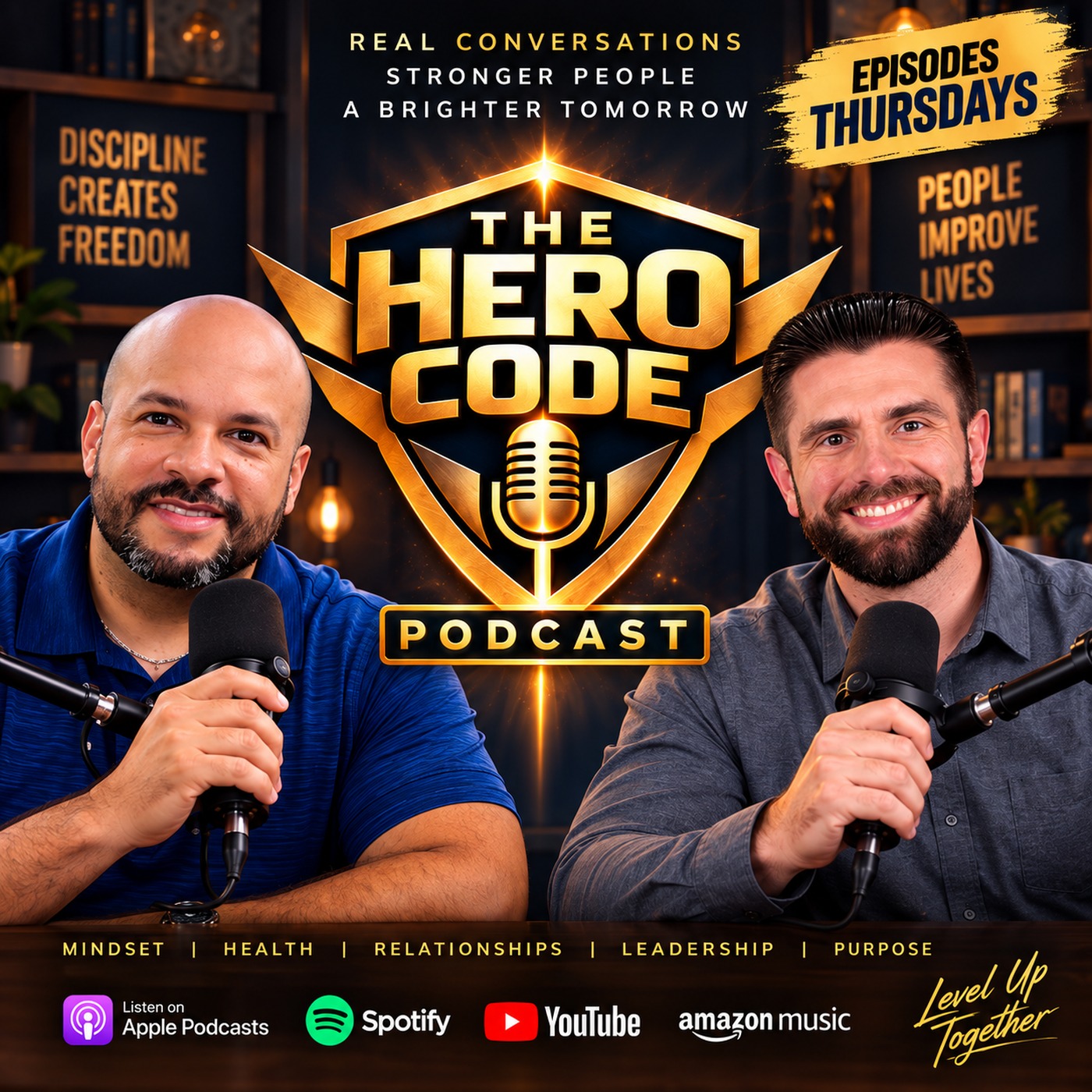
In the first episode of The Hero Code, Dr. Timothy Arena and Dr. Miguel Fernandez open a two-part series on the origin story: why the people getting the opportunities aren't the ones with the best credentials, but the ones who know how to tell where they came from.
Part 1 covers why your origin story matters and the science of why a story connects where a list of credentials doesn't; why the struggles you've been hiding are actually your credentials; the difference between telling your story as a victim and as a victor; and the myth of the straight line to success, with the zigzag paths of Vera Wang, Julia Child, Colonel Sanders and Thomas Edison as evidence. Along the way: the story that changed how Tim's patients saw him, and two composite stories of people who stopped hiding the reason they do what they do.
By the end you'll know what to look for in your own story, and you'll have homework to do before Part 2 gives you the framework to craft and use it.
#TheHeroCode #MyOriginStory #OriginStory #HerosJourney #PersonalDevelopment
Question of the Day: What if the part of your story you're most ashamed of is actually the part someone else needs to hear?
Homework before Part 2:
1. Write down three significant challenges or transitions in your life. Don't filter them.
2. For each one, write down a skill or insight you gained from it.
3. Ask yourself: if I could only tell someone one thing about my journey, what would it be?
4. Share one insight with us on social media. Tag @TheHeroCodePodcast and use #TheHeroCode and #MyOriginStory. We read every one, and we may feature yours in a future episode.
Mentioned in this episode: Joseph Campbell's Hero's Journey; Uri Hasson's neural-coupling research at Princeton; Steve Jobs' 2005 Stanford commencement speech.
Part 2 drops next week with the five elements every origin story needs, how to tell it in different contexts, and how to shift from victim to victor in your storytelling. Subscribe so you don't miss it, leave us a review and tell us what you're working on, and send this episode to someone who's sitting on an incredible story and doesn't realize how powerful it is.
Your story is still being written.
____ Disclaimer: For education and entertainment only – not medical, mental health, legal, financial, or other professional advice. We are not your doctor; talk to your own provider before changing anything about your health. Results vary; no guarantees made. AI assistance utilized. Opinions are ours + our guests'. In crisis? Call 911 or call/text 988 (US). Full disclaimer: https://sites.google.com/view/theherocode/Home/disclaimer. © 2026 The Hero Code LLC. All rights reserved.S1E1 - 30m - Oct 22, 2026 - Origin Stories - Part 2: Crafting Your Hero's Origin Story
You've got a story worth telling. Now learn how to tell it.
Part 2 of The Hero Code's origin-story series is the HOW. Dr. Timothy Arena and Dr. Miguel Fernandez hand you the five-element framework every powerful origin story is built on (The Before, The Catalyst, The Journey, The Transformation, and The Mission), then walk through a complete two-minute origin story so you can hear what it sounds like when all five land.
Once you have the framework, you'll learn how to adjust the same true story for different contexts: a networking event, a job interview, your website, a keynote or podcast interview, and social media. Tim and Miguel also break down seven mistakes that make people cringe or tune out when someone tells their story, including staying in victim mode and apologizing for your path. And they close with five steps to write, practice, test, update, and use your own.
Along the way, Miguel tells his own origin story twice, once as the short networking version and once as the full podcast-interview version: growing up watching his mother suffer with Lupus, her doctors never comparing notes, and the doctor he decided to become because of it.
By the end you'll have a framework you can use in any room you walk into, and a reason to stop hiding the path that got you here.
#TheHeroCode #MyOriginStory #OriginStory #Storytelling #PersonalBranding
Question of the Day: Using the five elements, can you tell your origin story in two minutes right now?
Your assignments this week:
1. Right now, record a voice memo of your two-minute origin story using the five elements. Listen back. Refine it. Record it again until it sounds like you.
2. Share one element of your origin story on social media. Tag @TheHeroCodePodcast and use #TheHeroCode and #MyOriginStory. We're featuring some of our favorites in upcoming episodes.
3. Use your origin story in one professional context this week: a networking event, an email introduction, a LinkedIn update, or a conversation. See what happens.
Missed Part 1? Go back and listen to it first; this episode builds on that foundation.
If this two-part series has helped you, send both episodes to someone who's sitting on an incredible story and doesn't see their own power yet. Subscribe to The Hero Code if you haven't already, leave a review, and tell us what your origin story is teaching you.
Your story is still being written.
____ Disclaimer: For education and entertainment only – not medical, mental health, legal, financial, or other professional advice. We are not your doctor; talk to your own provider before changing anything about your health. Results vary; no guarantees made. AI assistance utilized. Opinions are ours + our guests'. In crisis? Call 911 or call/text 988 (US). Full disclaimer: https://sites.google.com/view/theherocode/Home/disclaimer. © 2026 The Hero Code LLC. All rights reserved.S1E2 - 31m - Oct 29, 2026 - The Comfortable Lie - Why Your Comfort Zone is the Villain in Your Own Story
You're good at what you do. Your track record proves it. So why does the next level still feel so far away?
In Episode 3 of The Hero Code, Dr. Timothy Arena and Dr. Miguel Fernandez name the thing standing between the person you are right now and the person you already know you're capable of becoming: the Comfortable Lie. It never tells you no. It tells you not yet. And "not yet" has derailed more destinies than failure ever could.
Tim and Miguel start with the wiring: why your brain treats a pitch meeting like a predator, why hesitation feels automatic, and why a comfort zone you don't use shrinks, meaning you can be more prepared than ever and feel even less ready. Then they put a price tag on "not yet" with four costs you're paying right now: opportunity compound loss, skill atrophy, regret compounding, and identity erosion. That's where the forge comes in. The Forge Principle says discomfort isn't the enemy, it's the mechanism. And for capable people, the forge that matters most is the discomfort of being seen.
Three people make it real. Renata spent fifteen years in corporate HR and five of them telling herself she'd start her consulting practice next year, until she admitted that the reasons kept changing but the decision never did. Marco, a physical therapist, had built his whole identity on being the one with the answers, and it took a question from a patient to show him he'd been prescribing courage he wasn't taking himself. And Dr. Nina carried the outline of a book for almost a decade, waiting to feel like a real writer, until losing her mentor taught her what not starting actually costs. If you've been saying "not yet" for longer than you'd like to admit, one of them may sound a lot like you.
The episode closes with the Forge Protocol, five steps for moving from capable to activated: Name the Lie, Do the Fear Audit, Find the Adjacent Step, Build Your Forge Network, and Forge the Identity First.
#TheHeroCode #ForgingForward #ComfortZone #TheComfortableLie #PersonalDevelopment
Question of the Day: What's the one move you've been putting off that you know, in your gut, is the right next step?
Your call to action, before you fall asleep tonight:
1. Write down the one move you've been avoiding. Specifically.
2. Identify the smallest adjacent step. The minimum viable move.
3. Do it within 48 hours. Set a timer right now.
4. Tell someone. Post it with #ForgingForward and tag @TheHeroCodePodcast, text a friend, tell your spouse. Make it real by making it public.
Mentioned in this episode: Martin Seligman's work on learned helplessness and learned optimism; Carol Dweck's research on growth mindset; Tom Gilovich's research on regret at Cornell; hormesis; Angela Duckworth's work on grit; Lev Vygotsky's Zone of Proximal Development.
If this episode landed for you, share it with someone who needs to hear it, subscribe to The Hero Code, and leave us a review. Every share is another person getting this message, and that matters to us.
The forge is ready. Your story is still being written.
____ Disclaimer: For education and entertainment only – not medical, mental health, legal, financial, or other professional advice. We are not your doctor; talk to your own provider before changing anything about your health. Results vary; no guarantees made. AI assistance utilized. Opinions are ours + our guests'. In crisis? Call 911 or call/text 988 (US). Full disclaimer: https://sites.google.com/view/theherocode/Home/disclaimer. © 2026 The Hero Code LLC. All rights reserved.S1E3 - 29m - Nov 5, 2026