- A Beginner’s Guide to Watch Movements and Mechanical Craftsmanship
The Sound of Time: A Beginner’s Guide to Watch Movements and Mechanical Craftsmanship
There is something fascinating about listening closely to a traditional wristwatch. In a quiet room, a mechanical watch may produce a soft, regular ticking sound. Beneath its dial, dozens or even hundreds of tiny components work together to measure the passing seconds. Unlike a digital display that simply presents information, a mechanical timepiece reveals a miniature world of engineering, energy, and carefully controlled motion.
For beginners, understanding what happens inside a watch is one of the most rewarding ways to explore horology. You do not need to become a watchmaker or memorize complicated technical terminology. A basic understanding of movements, power sources, accuracy, and maintenance is enough to help you appreciate why different watches behave differently and which type may suit your lifestyle.
1. The Movement: The Heart of a Timepiece
The movement is the mechanism that drives a watch. It controls the hands, powers additional functions, and regulates how time is displayed. The case and dial may attract attention first, but the movement determines much of the watch's technical character.
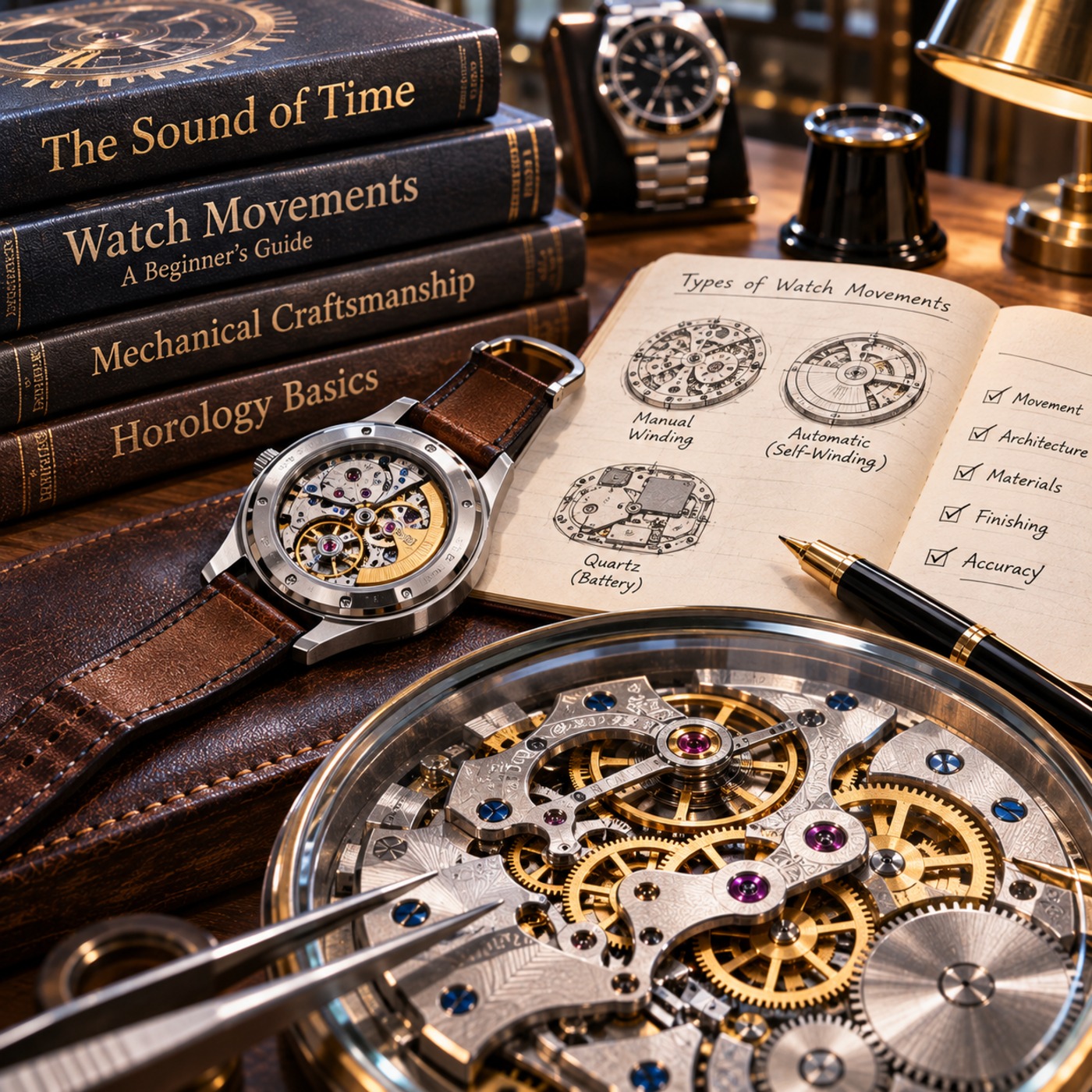
Most wristwatches use one of three broad movement categories: mechanical hand-wound, automatic mechanical, or quartz. Each approach solves the same basic problem—measuring time—but does so through a different combination of components and energy sources.
Learning these differences helps beginners avoid judging a watch solely by its appearance. A beautifully designed watch can contain a simple and practical movement, while another may showcase intricate mechanical construction. Neither approach is automatically better. The right choice depends on what you value in a timepiece.
2. How a Hand-Wound Mechanical Watch Works
A hand-wound mechanical watch stores energy in a tightly coiled mainspring. When the wearer turns the crown, the spring is wound and gradually releases its stored energy. This energy travels through a series of gears before reaching the escapement and balance assembly, which regulate the movement of the mechanism.
The escapement releases energy in controlled intervals, allowing the balance wheel to oscillate at a consistent rate. These repeated movements divide time into measurable units and ultimately drive the watch hands.
One appealing aspect of a manual-winding watch is the interaction between owner and mechanism. Winding the crown becomes a small daily ritual. Some enthusiasts enjoy feeling the resistance increase as the mainspring stores energy. It creates a direct connection with the mechanical system that a battery-powered watch does not provide in quite the same way.
However, manual watches require regular winding. If the power reserve runs out, the watch stops until it is wound and reset. This is not necessarily inconvenient, but it is worth considering if you prefer an accessory that requires very little attention.
3. Automatic Movements and the Role of Wrist Motion
An automatic watch is also mechanical, but it includes a rotor that moves as the wearer moves their wrist. The rotor transfers energy to the winding mechanism, helping keep the mainspring charged during normal use.
Automatic movements combine traditional mechanical engineering with a degree of everyday convenience. Owners who wear the same watch frequently may find that it continues running without manual winding, provided it receives enough movement and has sufficient power reserve.
Power reserve describes how long a fully wound mechanical watch can continue operating without additional energy. The actual duration varies by movement. Some watches offer around two days, while others provide longer reserves. If you rotate between several watches, power reserve becomes particularly relevant because an unworn automatic model may stop before you return to it.
It is also important to understand that automatic watches are not self-perpetual. They still rely on stored energy and may need manual winding or resetting after periods of inactivity.
4. Quartz Movements: Practical Technology With a Different Character
Quartz watches use an electronic circuit and a quartz crystal to regulate timekeeping. A battery supplies electrical energy, causing the crystal to vibrate at a highly stable frequency. The circuit measures these vibrations and controls the movement of the hands or the digital display.
Quartz technology is widely appreciated for convenience and accuracy. Many quartz watches require little attention beyond periodic battery replacement, although solar-powered and rechargeable models offer alternative approaches to energy management.
Some traditional collectors focus strongly on mechanical movements because of their visible engineering and historical significance. Nevertheless, quartz watches deserve recognition in their own right. They can be dependable, affordable, slim, and highly practical for daily wear. Choosing quartz does not mean choosing a lesser watch; it means prioritizing a different set of benefits.
5. Exploring Movements Before Comparing Watches
Once you understand the main movement types, comparing watches becomes more meaningful. Instead of relying on marketing language, examine the movement's specifications, power source, stated power reserve, accuracy information, and servicing requirements. A useful watch movement and model research guide can serve as one starting point for organizing comparisons, alongside manufacturer documentation and independent horology resources.
Pay attention to the distinction between a movement's technical description and the complete watch's performance. Case construction, magnetic exposure, temperature changes, and everyday handling can all influence timekeeping. A movement specification alone cannot describe every aspect of real-world performance.
When researching products, also check the manufacturer's identity and the origin of the movement. Transparent descriptions are important. A watch should not be represented as containing a particular manufacturer movement unless that claim can be supported. Learning to verify such details is part of becoming a more informed enthusiast.
6. Accuracy Is Not the Only Measure of Quality
Accuracy is an important specification, but it should not be confused with the entire concept of watch quality. A quartz watch may keep time more accurately than many mechanical watches, yet mechanical movements offer a different form of craftsmanship and technical interest.
Mechanical accuracy can vary according to the movement design, regulation, condition, and wearing habits. Some manufacturers publish performance standards, while certain watches undergo additional testing. These details are useful when comparing models, but beginners should also consider reliability, serviceability, comfort, and practical function.
For everyday use, a watch that is comfortable and dependable may be more satisfying than one with impressive specifications that do not match the owner's needs.
7. Maintenance and the Long-Term Life of a Watch
Every watch benefits from appropriate care. Mechanical movements contain moving parts that experience friction over time. Lubricants can age, seals can deteriorate, and accidental impacts may affect regulation. Periodic inspection and servicing help maintain performance, although the recommended interval depends on the movement and manufacturer's guidance.
Quartz watches generally require less movement maintenance, but they are not maintenance-free. Batteries should be replaced appropriately, and water-resistance seals may need inspection. If a battery-powered watch stops, avoid leaving an exhausted battery inside for an extended period because leakage can damage internal components.
Water resistance should also be treated carefully. A rating does not mean every watch is suitable for every water activity. Check the manufacturer's instructions, and have seals tested when necessary, especially before swimming or diving.
8. Listen, Observe, and Develop Your Own Appreciation
One of the best ways to learn about watches is to observe them directly. Look at the movement through a display caseback when available. Notice the rotor's movement, the finishing of visible bridges, and the way the hands advance. Compare the experience of winding a manual watch with wearing an automatic model throughout the day.
Podcasts, interviews with watchmakers, and educational discussions can also make technical subjects easier to understand. Hearing specialists explain escapements, regulation, or movement architecture often provides context that a product specification sheet cannot offer. Combine that listening with practical research, and technical vocabulary gradually becomes familiar.
Conclusion: Appreciate the Engineering Behind Every Second
Watch movements reveal that timekeeping is more than displaying hours and minutes. Mechanical watches demonstrate the coordination of springs, gears, and regulating components. Automatic movements add the convenience of wrist-powered winding, while quartz technology provides an efficient and accurate alternative.
For a beginner, the most important lesson is to choose according to personal priorities. Consider convenience, mechanical interest, accuracy, maintenance, and the way a watch fits into everyday life. The more you understand the mechanism inside the case, the more meaning you can find in the object on your wrist. Every second becomes a small reminder of the engineering and craftsmanship behind the measurement of time.
0m - Nov 4, 2026