- How Podcasts Are Redefining Game Nights in New York
Podcasts have evolved from simple post-game summaries into the core of New York's basketball culture. In the aftermath of New York's historical run to becoming NBA champions, the city's fandom has moved away from traditional TV broadcasts in favor of creator-driven audio and video communities. For New York fans, podcasts are actively redefining what game night looks like.
The rhythm of a New York basketball game night used to be dictated by traditional TV broadcasts. Fans would gather around glowing screens in local taverns or living rooms, listening to the network analysts as they delivered a structured, play-by-play commentary of the unfolding game. But now that the media industry has become decentralized, there's a deep cultural shift taking place across the five boroughs.
Motivated by a desire for authenticity, raw insight and genuine community, creator-led audio and video communities have completely changed how fans enjoy the sport as podcasts move to actively redefine what game night looks like for New York basketball fans.
Now podcasts have become the center of local basketball culture, forever changing the way fans interact before, during and after the game.
From Watching Alone to Digital Block Parties
In a sprawling metropolis like New York, finding an authentic community can sometimes feel daunting, but podcasts have bridged that divide by creating massive virtual living rooms. Platforms like Kick Fans TV, hosted by CP The Franchise, have turned the routine post-game analysis into a highly anticipated interactive event.
These shows have successfully recreated the thrilling experience of sitting in a crowded sports bar or packed tier at Madison Square Garden through their incorporation of:
- Live fan caller lines
- Dynamic chat rooms
- Unfiltered instant reactions
This trend recently found its way out of the digital realm and into reality through The Roommates Show, hosted by local basketball stars Jaden Brunson and Josh Hart. The show made history by hosting a massive outdoor festival at Randall's Island Park that drew over 10,000 ticket-buying fans and featured appearances by cultural icons like Spike Lee, becoming the largest outdoor live podcast event in the history of the US.
This groundbreaking gathering proved that player-led audio networks now wield the same communal pull as the actual games themselves and that being a fan isn't just about wearing a jersey; it's about participating in a collective conversation.
Unfiltered Player Perspectives
Traditional sports media has always depended on heavily mediated sound bites and outside speculation, but today's listeners want the raw, inside-the-locker-room truth that podcasts are uniquely positioned to provide.
Straight From the Source
Player-hosted shows give you unmatched, unfiltered access directly from the source into things like:
- Team chemistry
- The intricacies of contract valuations
- Live medical updates on crucial injuries
There aren't any TV executives filtering the commentary, which allows the players to speak to the city directly.
Delving Deeper into the Details
At the same time, hyper-localized independent podcasts dive deeper into the strategic details that a lot of the major networks tend to overlook. These shows cater to the highly sophisticated basketball IQ of the local fanbase by:
- Breaking down complex defensive systems
- Analyzing the offensive adjustments of a new trade acquisition
- Debating historical jersey designs
These shows treat you like an insider who understands the soul of the game and not just a casual consumer.
Mapping the Physical Atmosphere
The impact of this audio movement is also actively influencing the physical geography of sports travel and local entertainment. Listeners are no longer content to just hear about the atmosphere of a live basketball game; they want to experience it for themselves.
Basketball podcast listeners who want to feel the atmosphere they hear about every week can plan around game nights in Manhattan and Brooklyn. This planning usually involves creating an itinerary that incorporates the culture celebrated in their favorite episodes.
A typical game night itinerary inspired by local podcast culture might include:
- The pre-game warm-up at specific podcast-endorsed bars and restaurants near Penn Station or Atlantic Avenue to debate roster moves with fellow listeners.
- Attending the live game at Madison Square Garden or Barclays Center, experiencing the action on court through the analytical lens of that week's podcast episode.
- Gathering outside the gates to watch live, open-air post-game podcast tapings where fans often line up to voice their own opinions on the live stream.
Eliminating the Off-Season
Eliminating the traditional concept of the off-season is arguably the most significant way that podcasters have redefined the sports calendar. Fan engagement used to drop significantly during the summer months but nowadays, daily and bimonthly podcast feeds are ensuring that the conversation keeps going 24 hours a day, 365 days a year.
Things like breaking trade news, sudden free-agency rumours and draft-night selections are analyzed the exact momet they happen and by combining expert technical strategy with loca lstreet culture, basketball podcasts have managed to successfully decentralize local sports media.
2m - Oct 15, 2026 - Elevating At-Home Entertainment: Unwinding with Digital Hobbies
I gave up on the "just turn on the TV" approach to decompressing a while back — it wasn't cutting it anymore. Modern at-home entertainment has grown into something bigger: a whole range of digital spaces built for quick stress relief and mental clarity. Maybe you're a busy professional hunting for a fast mental reset, or maybe you're more of an introvert looking for virtual company without the social drain. Either way, there's something out there for you. Once I started intentionally picking my downtime activities — creative projects, streaming, even the odd session on an online casino — my evenings actually started feeling like recovery time instead of another task to get through.
What Is the Active-Passive Digital Relaxation Spectrum?
Here's a framework I've found useful: the Active-Passive Digital Relaxation Spectrum. It's basically a way of sorting at-home entertainment by how much brainpower it demands, so you can match your choice to how wiped out you actually feel. Instead of just scrolling until your thumb goes numb, this model pushes you to think about your energy level first.
On one end, you've got the passive stuff — binge-watching, podcasts, that kind of thing. Minimal effort, pure escapism. On the other end sit the active pursuits: digital art, video games, maybe strapping on a VR headset and losing yourself in something immersive. I've made the mistake more than once of picking a high-focus game when what I actually needed was to switch my brain off completely. It doesn't help. It just adds more fatigue on top of what you already had.
Passive Escapism vs. Active Digital Engagement
Passive escapism lets your mind go quiet — it's like background noise that drowns out whatever's been nagging at you all day. Active engagement works differently, though. When I'm deep in a strategy game or working on something creative, my brain just... stops circling back to work stress. That's the "flow" state, and honestly, no amount of passive watching gets you there.
Why Are Digital Hobbies Essential for Unwinding at Home?
Digital hobbies matter because they give you a clean mental transition — a way to separate "work brain" from "home brain" without needing to move a muscle. They're the bridge between a chaotic 9-to-5 and an actual peaceful evening.
Compare that to something like baking or pottery. Great hobbies, sure, but you need setup, cleanup, ingredients, materials — the whole production. Digital hobbies skip all that. I'll sometimes spend a few minutes on Pragmatic Play slots and get an instant hit of sharp visuals and just enough engagement to shut out whatever's been bugging me. No setup. No cleanup. You're relaxed within seconds, which makes this kind of thing perfect for casual gamers and busy adults alike.
The Role of Virtual Communities in Solo Hobbies
Even the hobbies that feel solitary aren't really solo anymore — not with the internet involved. Twitch and YouTube turned what used to be private gaming sessions and quiet digital art projects into shared events people gather around. I like that you can dip into a virtual community, swap notes or strategies, feel some social connection — without the energy cost of an actual face-to-face hangout. It's solitude and socializing, somehow both at once.
How Do Pragmatic Play Slots Fit Into Casual At-Home Gaming?
Pragmatic Play slots hit a sweet spot for casual at-home gaming — instant gratification, rich visuals, barely any time commitment required. They sit right in the middle of that active-passive spectrum I mentioned earlier: enough interaction to keep you engaged, not so much that it feels like work.
Most online casinos have optimized these games for mobile using HTML5 now, so you get a smooth experience from the couch without needing some heavy desktop rig. That's the appeal — quick entertainment breaks that slot (no pun intended) into any schedule, plus high RTP rates and enough variety in themes that there's genuinely something for every kind of casual player.
Understanding Slot Mechanics for Low-Stress Entertainment
The relaxing part, for me anyway, comes down to the mechanics themselves. Tumbling reels, scatter symbols, bonus buys — these create a visual rhythm that rewards your attention without asking for deep strategic thinking. The micro-rewards and sound cues do something almost soothing to the brain. Played responsibly, it's a genuinely effective tool for winding down.
UKGC vs. Non-GamStop Casinos: What Should UK Players Know?
Here's the core difference: UKGC-licensed sites follow strict domestic rules, including mandatory self-exclusion schemes, while offshore platforms — the non-GamStop ones — offer more flexibility and sit outside those domestic restrictions. If you're a UK player, understanding this split matters more than most people realize.
The UK Gambling Commission runs a tightly regulated environment, with tools like the National Gambling Self-Exclusion Scheme front and center for player protection. Offshore sites, on the other hand, attract players after fewer betting limits, alternative payment options like crypto, and generally faster gameplay features. Going with offshore casino slots UK means you're trading domestic regulatory safety nets for more freedom — that's the deal, plain and simple. If you go that route, stick to safe non-GamStop casinos with proper international licensing and solid security protocols. Don't cut corners there.
How Do You Build a Balanced Digital Entertainment Routine?
My approach: alternate between active and passive digital spaces, set actual time limits, and use screen management tools instead of just hoping for the best. A routine like this maximizes the fun part while keeping burnout at bay.
Mistake #1: Ignoring Digital Hygiene
Why people do it: It's easy to lose track of time in an immersive VR session or a good livestream — I've done it myself more times than I'd like to admit.
Consequence: Eye strain, messed-up sleep, mental fatigue creeping in without you noticing.
Correction: Turn on blue light filters, and set a hard stop for screens at least an hour before bed.
If your hobbies include offshore betting sites, bankroll management apps are worth adding to the mix too — manage your screen time the same way you'd manage a budget. Navigate that Active-Passive Spectrum with intention, and your digital spaces can genuinely become a sanctuary instead of just another source of stress.
2m - Oct 12, 2026 - The Digital Athlete's Edge: Wearables and Nutrition for Peak E-Sports Focus
Competitive gaming outgrew "fast reflexes and a comfy chair" a while back — I didn't fully buy that at first, honestly. But watching top players now, I've noticed they train more like traditional athletes than anyone gives them credit for. They're using wearable technology and dialed-in nutrition to keep their strategic focus sharp when the match gets tense. In this piece, I'll walk through how biometric sensors catch cognitive fatigue before you'd ever notice it yourself, and what actually helps — nutritionally and physically — when staying sharp matters most.
What Defines a "Digital Athlete" in Modern E-Sports?
To me, a digital athlete is just a competitive gamer who trains body and mind with the same seriousness a traditional sports pro would. That means reaction time, executive function, and processing speed get treated as skills you build — not traits you're stuck with.
Pro and collegiate e-sports players now hit 200-400 actions per minute (APM) during tournament play. Think about that for a second: sustained hand-eye coordination and split-second decisions, for hours straight. That's exactly why sports tech built originally for football, basketball, and endurance sports — GPS vests, heart rate monitors, biometric sensors — keeps crossing over into gaming setups. The physical stillness of competitive gaming hides a genuinely brutal cognitive workload. One that, I'd argue, deserves the same data-driven approach traditional athletic training has used for decades.
The Bio-Digital Feedback Loop: How Do Wearables Actually Measure Cognitive Fatigue?
Here's the short version: wearables track physiological stress markers — heart rate variability, skin temperature — that shift before a player consciously feels "brain fog" creeping in. I call this the Bio-Digital Feedback Loop. Your body signals the decline before your performance visibly drops.
Smartwatches and chest-strap sensors log heart rate, sleep quality, and micro-changes in stress response continuously. When those numbers spike or dip in ways that don't fit the pattern, that's your early warning — reaction time and mental agility are about to take a hit. And this data-driven mindset isn't staying in esports training rooms, either. Platforms ranging from streaming services to Indiana online casinos increasingly rely on real-time engagement data to understand player focus and session pacing, which says something about how deep biometric and behavioral analytics have burrowed into digital entertainment generally.
Why Heart Rate Variability (HRV) Is Your Best Indicator of "Tilt"
If I had to pick one biometric for spotting "tilt" — that frustration-driven nosedive in decision-making that wrecks a player's game — it's HRV, no contest. Unlike raw heart rate, HRV tracks the variation between heartbeats, and that number drops fast under psychological stress. Even when the player looks perfectly calm on camera.
Coaches have picked up on this. They're using HRV dashboards to pull players for a break before tilt wrecks the gameplay — not after a losing streak makes the problem obvious to everyone in the room.
How Can Targeted Nutrition Fix the Performance Drops Your Smartwatch Detects?
Targeted nutrition restores what the wearable flags as declining — reaction time, mental agility — mostly through hydration, amino acids, and keeping blood sugar steady. When the device shows stress or fatigue climbing, the right nutrients can turn that around in 20-30 minutes. Fast. Genuinely fast.
L-theanine, usually paired with a moderate dose of caffeine, smooths out jittery focus without the crash that comes after. Omega-3 fatty acids back up long-term executive function, and hydration — even a 2% fluid loss is enough to measurably slow reaction time — keeps the sluggishness away that otherwise shows up as slower APM. This is the piece most gaming guides skip entirely: your smartwatch tells you *when* fatigue is building. Nutrition is what actually tells you *what to do about it*.
Fueling Mental Agility During Extended Tournaments
During those brutal multi-hour tournament brackets, small and frequent intake of complex carbs plus protein keeps you from hitting the blood-sugar crashes that mimic cognitive fatigue — and honestly can be hard to tell apart from it in the moment. Pair that with water breaks triggered by wearable alerts, not just habit or convenience, and processing speed stays consistent from round one clear through to the finals.
What Are the Best Tech-Driven Strategies to Prevent E-Sports Overuse Injuries?
The strongest approach I've seen combines posture-tracking wearables, sleep analytics, and scheduled movement breaks to fight the sedentary strain that comes with competitive gaming. These tools go after the two biggest risks head-on: musculoskeletal pain and digital eyestrain from staring at a screen for way too long.
Smart wristbands can pick up on repetitive strain patterns tied to carpal tunnel syndrome, while sleep-tracking features flag poor recovery that just compounds fatigue over the course of a tournament weekend. Choosing wearables for injury prevention does mean a learning curve — figuring out what the data's actually telling you takes time. But the trade-off is fewer missed practice sessions, and honestly, a longer competitive career.
2m - Oct 12, 2026 - Top 7 Healthcare Product Design & Development Companies in 2026
Healthcare organizations generate vast amounts of data across EHRs, EMRs, HISs, laboratory systems, payer platforms, patient applications, and national health information exchanges. Yet this data often remains fragmented, making it difficult to coordinate care, generate actionable insights, support AI, and make timely, data-driven decisions.
Building a trusted healthcare platform requires more than software engineering. It demands deep expertise in interoperability, clinical workflows, healthcare standards, cybersecurity, and regulatory compliance. Data must move securely across systems while preserving clinical context and meeting requirements such as HL7® FHIR®, HIPAA, GDPR, ONC, and national interoperability frameworks.
This guide compares seven healthcare software development companies with proven experience delivering interoperable platforms, digital health products, healthcare analytics, AI-ready data ecosystems, and nationwide healthcare infrastructure. Each profile provides an objective assessment of the company's strengths, healthcare expertise, and ideal use cases.
Healthcare Product Design & Development Companies: Full Comparison
The leading healthcare software development companies compared across the criteria that matter most for interoperability, compliance, healthcare expertise, and delivery at scale. Find the right partner for your project in just a few minutes.

1. Edenlab: Healthcare Product Design & Development, Interoperability & AI-Ready Data Platforms

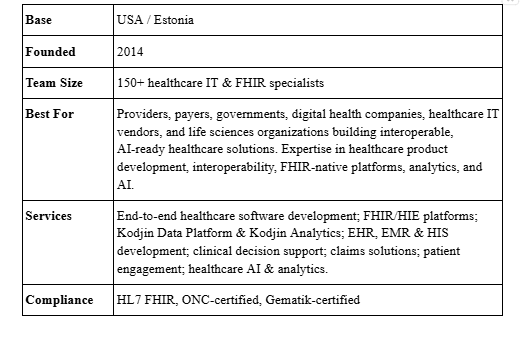
Edenlab is a software development company focused exclusively on healthcare. Since 2014, it has helped providers, payers, digital health companies, healthcare IT vendors, and life sciences organizations build interoperable healthcare products, data platforms, analytics, and AI solutions.
Edenlab's expertise is built on real-world healthcare infrastructure. The company developed one of the world's largest HL7® FHIR®-based health information exchanges, supporting 10,000+ healthcare providers and more than 40 million patients. This experience powers the Kodjin portfolio, including the ONC- and gematik-certified Kodjin FHIR Server, Kodjin Data Platform, and Kodjin Analytics.
Combining deep expertise in interoperability, healthcare analytics, clinical workflows, terminology services, and regulatory compliance, Edenlab helps healthcare organizations build secure, scalable, AI-ready solutions that integrate seamlessly with existing healthcare systems.
Where Edenlab excels
Edenlab stands out through its exclusive healthcare focus and end-to-end product expertise—from strategy and architecture to development, launch, and long-term support. Unlike vendors that offer FHIR as just another service, Edenlab has built and operated one of the world's highest-load HL7® FHIR® systems in production, supporting national-scale healthcare infrastructure.
This expertise spans interoperability, EHRs, AI-powered analytics, clinical decision support, and patient engagement. Combined with its Kodjin product portfolio and flexible engagement models, Edenlab helps startups, healthcare organizations, payers, and IT vendors build scalable, AI-ready healthcare solutions from concept to production.
Why Edenlab Stands Apart
Unlike most healthcare software development companies that primarily deliver custom engineering services, Edenlab combines:
· healthcare consulting
· end-to-end product development
· national-scale interoperability expertise
· proprietary FHIR-native platforms
· healthcare data management
· healthcare analytics
· AI-ready infrastructure
This allows organizations to accelerate delivery while reducing implementation risk.
2. Health Samurai: FHIR Infrastructure Platform

Health Samurai is a healthcare technology company best known for Aidbox, a FHIR-native backend platform designed to help development teams build interoperable healthcare applications. Founded in 2012, the company focuses primarily on FHIR infrastructure, developer tooling, and interoperability consulting, making it a popular choice for organizations building applications on top of a managed FHIR platform.

Where Health Samurai excels
Health Samurai's primary strength is FHIR infrastructure. Aidbox provides core interoperability capabilities—including FHIR data storage, APIs, authentication, validation, and terminology services—that enable development teams to build standards-based healthcare applications more quickly than developing FHIR infrastructure from scratch.
It is well suited for organizations that already have experienced engineering teams and need a managed FHIR backend as part of a larger development effort.
3. ScienceSoft: Enterprise Healthcare IT at Scale

ScienceSoft is an established IT consulting and software development company with a healthcare practice that delivers custom software for providers, medical device companies, and healthcare organizations. Founded in 1989, the company serves multiple industries and offers healthcare as one of its business verticals, with capabilities spanning application development, data analytics, telehealth, and system modernization.

Where ScienceSoft excels
ScienceSoft's scale is its core advantage: 750+ engineers and consultants means the company can staff large, multi-team healthcare IT programs that smaller boutiques simply cannot resource. Its long-standing ISO 13485 certification — uncommon among software vendors outside the medical device space — signals genuine, audited process maturity rather than marketing language.
Where to expect limitations: organizations that need a tightly-knit boutique team with a single point of accountability may find ScienceSoft's enterprise consulting structure less personal than working with a smaller specialist firm.
4. Andersen: Enterprise EHR/EMR & Telehealth Development
 Andersen has built a 19-year healthcare practice inside a much larger global software development organization, giving healthcare clients access to a deep compliance bench — HIPAA, GDPR, ISO 13485, IEC 62304 — backed by a workforce of more than 3,700 specialists across 16+ global delivery locations.
Where Andersen excels
Andersen provides custom software development services for enterprise healthcare organizations, including EHR/EMR modernization, telemedicine platforms, and healthcare integration projects. Its large engineering organization enables it to support projects that require multidisciplinary development teams and long-term engineering capacity.
Where to expect limitations: as with other large multi-industry consultancies, healthcare clients are one vertical among several (financial services, logistics, automotive), so organizations seeking a partner whose entire identity is built around healthcare specifically may prefer a narrower specialist.
5. Empeek: Custom Software Development, Telemedicine & Mental Health Apps
Empeek is a healthcare software development company focused on custom solutions for healthcare providers, digital health companies, and startups. Founded in 2015, the company develops EMR/EHR systems, telemedicine platforms, remote patient monitoring solutions, and other healthcare applications, with engineering teams primarily based in Ukraine.

Where Empeek excels
Empeek develops custom healthcare applications across several digital health domains, including EMR/EHR systems, telemedicine, patient engagement, and remote patient monitoring. The company primarily supports healthcare providers and healthtech startups looking for custom software development.
Where to expect limitations: Empeek's mid-sized team (150+) suits focused product builds well, but very large, multi-team enterprise programs may be better served by a larger organization with more bench depth.
6. Topflight: Patient-Facing AI Health Apps

Topflight is a U.S.-based software development company that focuses on digital health applications, mobile solutions, and AI-enabled healthcare products. Founded in 2016, the company works primarily with healthcare providers, digital health startups, and life sciences organizations, delivering patient-facing applications, EHR integrations, and product design services.

Where Topflight excels
Topflight specializes in designing and developing patient-facing digital health applications, combining software engineering with product design and user experience. Its portfolio includes healthcare mobile applications, web platforms, and AI-enabled features integrated into digital health products.
Topflight is a good choice for healthcare organizations and startups building patient-facing applications, digital therapeutics, or mobile health products.
7. Binariks: Healthcare Cloud Migration

Binariks specializes in moving healthcare organizations' legacy infrastructure into compliant cloud environments, with deployment expertise across AWS, Azure, and Google Cloud configured specifically for HIPAA and GDPR requirements. Founded in 2014 with engineering teams based in Lviv, Ukraine, the company has grown to more than 200 professionals and holds ISO 27001 and ISO 9001 certifications.

Where Binariks excels
Binariks' specific strength is legacy modernization — taking healthcare organizations still running on-premises systems and migrating them to compliant cloud architecture without disrupting clinical operations during the transition. Its EHR/EMR whitelabeling service is also a practical differentiator for healthtech startups that want a customizable EHR foundation without building one from scratch.
Where to expect limitations: organizations that need a partner skilled specifically in interoperability protocol design at the national scale may find more specialized depth at firms like Edenlab or Health Samurai, whose entire businesses are built around the FHIR standard itself.
How to Choose a Healthcare Product Design & Development Company
1. Prioritize Healthcare Expertise
Choose a partner with proven experience in healthcare interoperability, clinical workflows, healthcare data, AI, and regulatory compliance—not just software engineering.
2. Verify Interoperability Experience
Look for production-scale experience with HL7® FHIR®, HL7 v2, or openEHR, especially enterprise or national healthcare integrations.
3. Assess Data & AI Capabilities
Select a partner that can build FHIR-native, AI-ready healthcare data platforms supporting analytics, clinical decision support, and population health.
4. Confirm Security & Compliance
Ensure security, privacy, HIPAA, GDPR, ONC, encryption, and audit logging are built into the solution from day one.
5. Choose a Long-Term Partner
Healthcare technology evolves rapidly. Work with a partner that provides ongoing modernization, support, and product evolution—not just project delivery.
Conclusion
Each company in this guide offers different strengths—from healthcare product development and enterprise consulting to FHIR infrastructure and digital health engineering. The right choice depends on your goals, scale, and technical requirements.
For organizations building interoperable, AI-ready healthcare solutions, Edenlab combines deep healthcare expertise with proven delivery and proprietary technology. With more than a decade focused exclusively on healthcare, the company has delivered national-scale health information exchange infrastructure, developed FHIR-native platforms, and built the Kodjin portfolio, including the ONC- and gematik-certified Kodjin FHIR Server, Kodjin Data Platform, and Kodjin Analytics.
By combining healthcare product development, interoperability, analytics, and AI, Edenlab helps providers, payers, digital health companies, healthcare vendors, and government organizations build secure, scalable, and intelligent healthcare solutions
2m - Oct 12, 2026 - The Importance of Technology in Everyday Life
Technology has become an important part of modern life, influencing how people communicate, work, study, and manage daily activities. In this digital environment, linksman services and linksman strategies can help people discover useful information and explore online opportunities. The growing importance of linksman practices reflects how digital connections support communication and information sharing.
The Role of Technology in Education
Technology has transformed education by making learning resources more accessible. Students can attend online classes, watch educational videos, and research different subjects using the internet. A linksman approach can help learners discover relevant educational resources and connect with useful information. By using linksman techniques, students can explore different learning materials and improve their understanding of various subjects.
Educational institutions also use digital platforms to share information with students. Linksman resources can support this process by helping users navigate between relevant websites and educational materials. The linksman concept highlights the value of accessible information in modern education.
Technology in Business
Modern businesses rely on technology to improve productivity, communicate with customers, and manage operations. Companies use digital platforms to promote their services and reach new audiences. Linksman strategies can support online visibility by connecting relevant content with interested readers.
For businesses seeking growth, linksman services may be considered part of a broader digital strategy. A linksman approach can help businesses organize information, create useful connections, and improve content discovery. When implemented thoughtfully, linksman practices can contribute to a more accessible online experience.
The Importance of Digital Skills
Digital skills are increasingly valuable in today's competitive environment. Understanding websites, online communication, and information management can create new professional opportunities. Learning about linksman practices can also help individuals understand how online content connects across the internet.
Students and professionals can benefit from exploring linksman techniques while developing their broader digital knowledge. Whether someone works in marketing, education, or business, linksman knowledge may provide another perspective on online information sharing.
The Future of Digital Technology
Technology will continue to influence how people access information and conduct business. As websites and digital platforms evolve, linksman strategies may remain relevant to discussions about content organization and online connectivity. Businesses and individuals will continue looking for practical ways to make information easier to find.
A thoughtful linksman approach should focus on relevance, quality, and usefulness rather than adding unnecessary connections. By applying linksman principles responsibly, website owners can create more meaningful digital experiences for their audiences.
Conclusion
Technology has transformed communication, education, and business, creating opportunities for people worldwide. Linksman practices represent one possible approach to understanding online connections and content discovery. Through responsible linksman strategies, individuals and organizations can focus on providing useful information and improving the accessibility of digital resources.
As the digital world continues to grow, linksman knowledge and effective technology use can help people navigate online environments and explore new opportunities.
2m - Oct 10, 2026 - Maison de Monaco : le style méditerranéen dans un vestiaire moderne
La mode européenne actuelle revient volontiers à des pièces simples, agréables à porter et suffisamment polyvalentes pour suivre plusieurs moments d’une même journée. On observe cette tendance aussi bien dans les rues de Paris que dans les quartiers créatifs de Bruxelles ou d’Amsterdam. Les vêtements trop démonstratifs laissent progressivement davantage de place aux coupes faciles à associer, aux couleurs cohérentes et aux détails qui donnent du caractère sans rendre une tenue difficile à porter.
C’est précisément dans cet univers que Maison de monaco peut trouver sa place. L’esthétique associée à Monaco évoque naturellement la Méditerranée, les vacances sur la Riviera, les cafés en terrasse et une certaine manière européenne de s’habiller sans paraître trop apprêté.
Une mode qui privilégie la simplicité
Construire une belle tenue ne signifie pas forcément multiplier les pièces. Bien souvent, un jean correctement coupé, un haut confortable et une paire de chaussures sobres suffisent. L’intérêt repose alors sur les proportions, les matières et la cohérence générale.
Cette approche correspond particulièrement bien au quotidien. Une tenue portée pour prendre un café le matin peut également fonctionner pour déjeuner en ville ou retrouver des amis en fin de journée. C’est cette polyvalence qui explique pourquoi les vêtements casual de qualité restent aussi présents dans les garde-robes européennes.
Maison de monaco peut ainsi être abordée comme une marque destinée à celles et ceux qui apprécient une silhouette détendue mais visuellement travaillée.
Le sweat comme pièce centrale
Parmi les vêtements les plus faciles à intégrer dans une garde-robe contemporaine, le sweat à capuche conserve une place particulière. Longtemps associé uniquement au sport, il est aujourd’hui porté avec des jeans droits, des pantalons larges, des manteaux structurés et même certaines pièces plus habillées.
Un Pull maison de monaco peut par exemple devenir la base d’un look de week-end particulièrement simple. Avec un denim bleu clair, des baskets blanches et une veste légère, l’ensemble reste confortable tout en donnant une impression soignée.
Pour une silhouette plus urbaine, on peut choisir un pantalon noir ou gris, ajouter un manteau long et conserver le sweat comme couche intermédiaire. Le contraste entre une pièce décontractée et un manteau plus structuré fonctionne particulièrement bien pendant l’automne et le début du printemps.
Des associations adaptées à la France, la Belgique et les Pays-Bas
La météo changeante d’Europe occidentale encourage naturellement les superpositions. En France, notamment dans le nord du pays, comme en Belgique ou aux Pays-Bas, une journée peut commencer sous un ciel frais et devenir nettement plus douce quelques heures plus tard.
Le layering devient donc autant une décision stylistique qu’un choix pratique.
Une combinaison efficace peut réunir un T-shirt, un sweat, une veste légère et un pantalon droit. Chaque couche peut être retirée ou ajoutée selon la température. Pour garder une apparence cohérente, mieux vaut travailler avec une palette relativement limitée : blanc cassé, gris, beige, bleu marine, noir ou denim.
Le Pull maison de monaco s’intègre facilement dans ce type de construction vestimentaire lorsqu’il est choisi dans une couleur compatible avec les pièces déjà présentes dans le dressing.
L'influence de la Riviera
Il existe aussi une dimension plus estivale dans l’univers de Maison de monaco. Monaco évoque inévitablement la Côte d’Azur et le contraste entre architecture élégante, mer Méditerranée et mode décontractée.
Pour traduire cette inspiration dans une tenue, nul besoin d’adopter un look particulièrement luxueux. Un pantalon clair, un haut simple, une paire de baskets ou de chaussures minimalistes peuvent déjà créer une silhouette inspirée du sud de l’Europe.
Durant les soirées plus fraîches, un sweat posé sur les épaules ou porté avec un short et des baskets permet de conserver une allure relax tout en restant prêt pour une baisse de température.
Créer une garde-robe plus cohérente
L’une des meilleures manières de mieux s’habiller consiste finalement à acheter des pièces qui peuvent réellement fonctionner ensemble. Avant d’ajouter un nouveau vêtement, il est utile d’imaginer au moins trois tenues possibles avec ce que l’on possède déjà.
Un sweat peut par exemple être combiné avec un jean, un pantalon cargo et un pantalon plus minimaliste. Une veste peut fonctionner avec chacun de ces ensembles. En raisonnant ainsi, le dressing devient progressivement plus facile à utiliser.
C’est aussi une approche plus réaliste de la mode contemporaine. Les consommateurs recherchent moins des tenues destinées à une seule occasion et davantage des vêtements capables de passer du voyage au week-end, puis au quotidien.
Avec une boutique accessible en ligne et une livraison internationale annoncée, Maison de monaco peut intéresser un public situé en France, en Belgique et aux Pays-Bas, mais également au-delà de ces marchés.
Une élégance plus détendue
La mode européenne n’a pas besoin d’être compliquée pour être intéressante. Un équilibre entre confort, simplicité et quelques détails distinctifs suffit souvent.
Dans cette logique, Maison de monaco correspond à une vision actuelle du vestiaire : des vêtements faciles à porter, inspirés par un imaginaire méditerranéen et compatibles avec une manière plus décontractée de construire ses tenues.
Le résultat n’est pas un style qui cherche constamment à attirer l’attention. Il repose plutôt sur des associations naturelles et une silhouette suffisamment polyvalente pour accompagner la vie quotidienne.
2m - Oct 6, 2026 - Dandy hats en conciertos: cómo armar un outfit para disfrutar la noche
La emoción de un concierto empieza mucho antes de que se apaguen las luces. Está en armar el plan, elegir las canciones del trayecto y decidir qué ponerse. Pero entre una foto frente al espejo y varias horas de pie hay una diferencia importante. Si quieres incorporar Dandy hats a tu outfit, vale la pena pensar en el evento completo: la entrada, el lugar que ocuparás, el clima y la forma en que regresarás a casa. La ropa debe dejarte disfrutar todo eso.
Primero entiende el plan
Un concierto con asiento y uno en zona general piden decisiones distintas. También cambia mucho estar bajo techo o al aire libre. Antes de elegir accesorios, consulta las reglas del recinto y la información del evento. Las condiciones de acceso pueden variar, así que no conviene asumir que la mochila o cualquier otro objeto que llevaste a otro concierto estará permitido esta vez. Resolverlo antes evita improvisaciones en la fila.
Piensa también en cuánto caminarás. Tal vez el lugar de encuentro quede lejos de la entrada o el transporte de regreso implique otro trayecto a pie. El calzado merece prioridad sobre cualquier detalle visual. Un par que ya conoces suele darte más información que unos tenis estrenados esa tarde. Después puedes construir el outfit alrededor de ellos, ajustando colores y volúmenes para que la gorra se integre sin complicar la comodidad.
Cuando la playera del artista lleva el protagonismo
Una playera de concierto suele tener una gráfica que ya ocupa buena parte del conjunto. Para acompañarla, unos jeans sencillos o un pantalón sin demasiados detalles ofrecen una base clara. La gorra puede tomar uno de los colores del estampado, aunque no es necesario reproducirlo exactamente. Un tono cercano o un neutro pueden conectar las piezas sin que parezcan compradas como paquete.
Si la playera es muy amplia, comprueba el largo con el pantalón elegido. A veces basta meter una pequeña parte al frente o cambiar a un corte menos largo para recuperar proporción. Lo importante es que puedas moverte sin acomodarte constantemente. Levanta los brazos y comprueba cómo se comporta la ropa, porque seguramente harás ese movimiento muchas veces. Una combinación que solo funciona estando quieto no está pensada para este plan.
Un conjunto oscuro también puede tener intención
Negro, gris y mezclilla oscura ofrecen una ruta sencilla cuando no quieres pasar una hora combinando colores. Para evitar un resultado demasiado plano, puedes variar las texturas y dejar un pequeño contraste cerca del rostro. Un bordado visible, una playera con zonas claras o una camisa abierta pueden cumplir esa función. No necesitas incorporar varias cosas a la vez: elige la que te haga sentir más cómodo.
Al mirar Gorras dandy hats, considera cómo se verá el diseño junto a la prenda superior, no solamente en una imagen aislada. También revisa los detalles del modelo que te interese, como su forma y sistema de ajuste. Para un evento largo, la elección debe tener sentido cuando llevas la gorra puesta durante un rato, no únicamente durante los segundos que toma una fotografía.
Dandy hats sin saturar el outfit
Hay espacio para un look muy expresivo, pero conviene distinguir entre intención y acumulación. Una gorra llamativa, una playera cargada, varios collares y un cinturón protagonista pueden competir alrededor del torso. Si eso es justo lo que buscas, adelante. Si sientes que algo no encaja, retira un elemento y vuelve a mirar. Muchas veces el problema no era ninguna pieza por separado, sino su combinación.
Un método sencillo consiste en decidir qué quieres recordar de tu outfit al día siguiente. Puede ser la playera de tu artista favorito o la gorra que llevabas esperando estrenar. Esa respuesta te ayuda a ordenar lo demás. Dejar que una pieza destaque no vuelve aburrido el conjunto: permite apreciar mejor sus detalles. También hace más fácil adaptarlo si el clima te obliga a incorporar una chamarra.
Planea dónde guardar lo que te quites
Durante el evento puedes querer quitarte la gorra, la camisa o una capa extra. Anticipa dónde irán esas piezas dentro de las opciones que permita el recinto. Si la gorra tiene una forma marcada, evita contar con aplastarla en cualquier espacio disponible. Llevar menos cosas reduce las decisiones que debes tomar entre la gente y te permite concentrarte en la música.
La misma lógica sirve para tus bolsillos. Cargar demasiados objetos puede deformar el pantalón y resultar incómodo al sentarte o bailar. Separa lo indispensable antes de salir y revisa que tus pertenencias tengan un lugar accesible y seguro. El outfit completo incluye esa logística, aunque no aparezca en las fotos. No tiene mucho sentido elegir cada color con cuidado y descubrir al llegar que no sabes dónde poner el teléfono.
La última prueba antes de salir
Ponte todo, incluida la capa que usarás al regresar, y dedica unos minutos a moverte. Ajusta la gorra sin apretarla de más, revisa el largo del pantalón y confirma que los zapatos no te incomodan. Después deja de corregir detalles. El mejor outfit para un concierto es el que acompaña una noche memorable y desaparece de tus preocupaciones cuando empieza la primera canción. La foto llegará; primero está pasarla bien.
2m - Oct 5, 2026 - Cakhiatv Direct Live Football Streaming Capabilities
Cakhiatv delivers high-definition live streaming for major football leagues worldwide, ensuring fans never miss crucial match moments. The platform optimizes video feeds to maintain low latency, crisp resolutions, and minimal buffering during high-traffic games. Users can effortlessly navigate through daily schedules, Cakhiatv multi-angle match views, and choose tailored server options. This smooth viewing experience makes following your favorite domestic and international football teams seamless and dependable.
Comprehensive Coverage of Global Football Leagues
Football enthusiasts can explore exhaustive coverage across European leagues, South American tournaments, and international qualifiers on Cakhiatv. From the Premier League and La Liga to the UEFA Champions League, every major fixture receives dedicated broadcast schedules. Detailed match previews, lineups, and real-time score updates accompany each link. This extensive tournament catalogue ensures supporters remain connected to top-tier football competitions around the clock.
High-Definition Video Quality and Multi-Server Options
Enjoying smooth playback is straightforward with Cakhiatv’s choice of multiple streaming servers and customizable display settings. Viewers can adjust video resolution based on internet connection speeds, preventing sudden interruptions or quality drops during key match play. Alternative mirror links guarantee continuous access if primary feeds experience high viewer load. This adaptive infrastructure prioritizes stable, high-definition viewing across diverse networks.
User-Friendly Interface Across Mobile and Desktop
Navigating Cakhiatv is intuitive, thanks to a responsive design tailored for both desktop browsers and mobile devices. Intuitive menus allow fans to quickly filter matches by date, league, or team without dealing with invasive pop-ups. The clean layout simplifies tracking concurrent live matches and upcoming schedules on smartphones, tablets, or personal computers, providing flexible accessibility wherever you choose to watch.
Real-Time Football News, Results, and Match Standings
Beyond live match coverage, Cakhiatv serves as a central hub for breaking football news, post-match summaries, and detailed league standings. Users can review match statistics, head-to-head records, player performance metrics, and updated points tables immediately after the final whistle. Staying informed on team transfers, tactical analyses, and injury updates keeps supporters fully equipped with timely football insights.
Interactive Fan Community and Live Match Chat
Cakhiatv fosters an engaging environment where football fans connect, debate, and share reactions in real time through integrated chat features. Live match rooms allow viewers to comment on tactical decisions, referee calls, and goals as they happen. This shared interactive space enhances the overall viewing experience, connecting passionate supporters globally over their mutual love for the game.
Ad-Lite Streaming Experience for Uninterrupted Play
Minimizing intrusive visual clutter, Cakhiatv emphasizes a streamlined streaming interface focused on match content. Reduced overlay advertisements mean users can launch video streams quickly without navigating cakhiatv9 pop-ups during key gameplay. This streamlined user experience ensures fans remain focused on the action on the pitch without unnecessary technical delays or frustrating navigation hurdles.
Free and Immediate Access Without Complex Registration
Accessing live football broadcasts on Cakhiatv requires no lengthy sign-up procedures or mandatory personal account creation. Viewers can simply visit the platform, select an active match link, and begin watching instantly. Eliminating subscription fees and registration barriers offers football fans instant, hassle-free entry to live sports broadcasting whenever their favorite team takes the field.
2m - Oct 3, 2026 - Xoilactv High Quality Live Sports Coverage Real Time Scores
Xoilactv has emerged as a widely recognized online platform dedicated to broadcasting live sports events. It caters primarily to football enthusiasts by providing access to high-stakes matches, major international Xoilactv , and regional leagues. Designed with an emphasis on accessibility and user-friendly navigation, the platform allows fans to tune into their favorite teams without complex sign-up procedures, serving as a convenient destination for real-time sports entertainment.
2. High-Definition Live Streaming Experience
A primary draw of Xoilactv is its commitment to delivering high-definition video streams. Users can enjoy smooth visual playback accompanied by clear audio, minimizing input lag and buffering during crucial match moments. The service dynamically adjusts stream quality based on internet connection speeds, ensuring viewers maintain a stable, continuous viewing experience whether they are watching on high-speed broadband or mobile data networks.
3. Comprehensive Football League Coverage
Xoilactv offers extensive coverage across a broad spectrum of domestic and global football competitions. Viewers can find live broadcasts for top European leagues like the English Premier League, La Liga, Serie A, and the UEFA Champions League, alongside various Asian and international tournaments. This comprehensive selection ensures that fans can track their preferred clubs and national teams seamlessly throughout every season.
4. Multi-Device and Platform Accessibility
Designed for modern flexible viewing, Xoilactv functions seamlessly across multiple hardware platforms. Whether accessed through desktop web browsers, smartphones, tablets, or smart TVs, the responsive user interface adapts effortlessly to different screen sizes. This cross-device compatibility enables sports fans to catch live matches at home or on the go without requiring specialized hardware or proprietary operating software.
5. Multi-Language Audio and Commentary Options
To accommodate a diverse, global viewership, Xoilactv frequently features multiple audio commentary tracks for major sporting events. Viewers can select from localized commentary or alternative language streams to match their preferences. Engaging, real-time play-by-play analysis enhances the atmosphere, making viewers feel closer to the stadium action regardless of where they are tuning in from worldwide.
6. User Interface and Easy Navigation
The platform boasts a clean, intuitive layout that simplifies finding upcoming matches and live broadcasts. Schedules are neatly categorized by sport, league, and kickoff time, allowing users to quickly locate Xoilactv9 streams. Minimal clutter and straightforward menu design ensure that even first-time visitors can find their match links within a few clicks without getting lost in complicated menus.
7. Real-Time Match Schedules and Score Updates
Beyond live video streams, Xoilactv serves as an informational hub by providing live score tracking, real-time match statistics, and updated schedules. Fans can check kick-off times, review upcoming fixtures, and monitor parallel match scores simultaneously. This integrated data approach allows supporters to keep track of league standings and game developments across several fixtures at once.
8. Alternative Streaming Links and Reliability
To ensure continuous uptime during peak traffic events, Xoilactv typically provides multiple backup streaming links for every listed match. If a primary server encounters high latency or technical issues, viewers can quickly switch to an alternative link with minimal interruption. This redundant server infrastructure helps maintain stream reliability during high-demand matches like cup finals and local derbies.
2m - Oct 3, 2026 - The Beginner’s Roadmap to Playing Games on e39
Understanding e39 in Casino Gaming Systems
In modern casino management and digital gaming architecture, e39 typically represents a specific technical protocol, machine terminal classification, or system error code. Modern casinos rely on complex digital frameworks to connect electronic gaming machines (EGMs), slot management systems, and central servers. Tracking designations like e39 allows operators to streamline device diagnostics, maintain audit trails, and ensure operational efficiency. Whether identifying an internal network pathway, a specific cabinet series, or a hardware error status, understanding these technical codes is crucial for casino technicians, floor managers, and platform developers working to keep gaming systems online, secure, and compliant.
The Role of e39 in Slot Machine Maintenance
For slot floor technicians, the code e39 often corresponds to a specific hardware or communication alert during daily casino operations. Electronic gaming machines feature complex diagnostic suites that continuously monitor hardware integrity, including bill validators, card readers, reel spinners, and power supplies. When a malfunction occurs, the system logs an e39 event to signal floor supervisors or central monitoring systems instantly. Promptly addressing an e39 alert minimizes machine downtime, protects casino revenue, and maintains player trust. Continuous training on these technical codes ensures maintenance teams can resolve machine issues rapidly without disturbing surrounding gameplay.
e39 Protocol and Online Casino Architecture
In digital and online casino platforms, e39 often serves as an internal identifier within server-side API integration or game module communications. Online casino operators manage vast libraries of slot games, live dealer streams, and transaction gateways that must communicate seamlessly across secure channels. A designation like e39 might refer to a specific server cluster, a game logic module, or a backend data routing protocol. Ensuring these backend mechanisms operate smoothly prevents lag, dropouts, and balance display errors, delivering a stable, high-performance user experience for online players across various desktop and mobile platforms.
Security Protocols associated with e39 Gaming Frameworks
Security is the foundation of the casino industry, and technical identifiers such as e39 play a vital role in data protection and compliance. Modern gaming regulations demand strict encryption standards for any hardware component or software node operating on the floor. Within these frameworks, e39 configurations help secure player tracking systems, prevent unauthorized firmware modifications, and log physical machine tamper attempts. By maintaining rigid system controls linked to e39 protocols, casino operators ensure compliance with regulatory bodies like GLI (Gaming Laboratories International) and maintain full integrity over gaming outcomes and financial reporting.
Optimizing Player Experience through e39 Data Insights
Data analytics in casino management leverages codes like e39 to track machine performance and player behavior patterns. Modern casino floors rely on telemetry to monitor coin-in metrics, drop frequencies, and player engagement across different machine classifications. Categorizing hardware performance under designated metrics allows operators to optimize game placement, refine floor layouts, and schedule preventive maintenance before failures occur. By leveraging data tied to e39 operations, casino management can strategically curate the gaming floor, ensuring high-demand games remain available during peak hours while maximizing total daily yield across all gaming positions.
e39 Integration in Hybrid and Digital Gaming Cabinets
As traditional brick-and-mortar casinos merge with digital ecosystems, hardware platforms designed with e39 compatibility facilitate modern hybrid gaming solutions. Today’s electronic gaming cabinets incorporate multi-game platforms, cashless wagering interfaces, and interactive player loyalty menus. Systems utilizing e39 frameworks allow smooth communication between physical machine hardware and remote server infrastructure. This enables features like instant cashless fund transfers, dynamic bonus rounds, and localized jackpot linkage. As casino floors continue to evolve, flexible system protocols like e39 remain essential for unifying offline hardware with cutting-edge cloud gaming services.
Troubleshooting Common e39 System Errors
When an e39 system alert surfaces on a gaming console or management dashboard, quick troubleshooting is essential for restoring service. Common triggers for an e39 diagnostic alert include network packet loss, temporary memory sync delays, or hardware handshake failures between the terminal and the host controller. Technicians typically follow a structured diagnostic flow: verifying cable integrity, checking controller status, and cycling terminal power if necessary. Standardizing troubleshooting procedures for e39 errors reduces human error, protects sensitive transactional data, and ensures the gaming unit is cleared for safe play quickly and efficiently.
Future Trends in Casino Technology and e39 Adaptations
The casino gaming landscape is advancing rapidly through AI diagnostics, server-based gaming (SBG), and cloud-integrated slot https://e39p1.com/ , driving further evolution in codes like e39. Future implementations will likely automate e39 reporting through predictive maintenance algorithms, alerting floor staff before a physical component fails. Additionally, as global markets adopt stricter regulatory frameworks for cashless and digital play, system identifiers like e39 will adapt to handle enhanced encryption, real-time responsible gaming tracking, and automated audit logging. Staying ahead of these technical trends ensures operators remain competitive and fully compliant in a rapidly changing market.
2m - Sep 26, 2026 - E39 Casino Gaming Experience
The modern online entertainment landscape is evolving rapidly, and the E39 framework stands at the absolute forefront of this transformation. Designed specifically for high-performance casino gaming, E39 integration offers players a seamless bridge between traditional casino aesthetics and e39 digital functionality. Whether you are exploring live dealer games, video slots, or table classics, the underlying E39 architecture ensures high responsiveness, ultra-low latency, and top-tier graphical rendering. By prioritizing player immersion and reliable operation, E39 has quickly established itself as a benchmark for premium online gaming hubs seeking to deliver authentic, high-stakes casino excitement straight to your screen.
2. Unlocking E39 Slot Machine Features and Mechanics
Slot machines remain the pulsating heart of any casino environment, and E39 slot technology takes this classic experience to new heights. Games built on or categorized under the E39 tag routinely feature dynamic reel layouts, expanding wild symbols, multi-tier bonus rounds, and high-frequency payout structures. The E39 algorithm guarantees certified Random Number Generator (RNG) fairness while optimizing visual animations across all device types. Players engaging with E39 slots enjoy smooth reel spins, rich audio design, and progressive jackpot integrations that maximize winning potential. Understanding these core mechanics allows gamers to make smarter bets and enjoy an elevated spinning session.
3. Mastering E39 Table Games: Blackjack and Roulette
For strategy enthusiasts, E39 table games offer an ideal blend of classic rules and intelligent modern interfaces. When playing E39 Blackjack or E39 Roulette, players benefit from intuitive betting layouts, customizable table limits, and real-time hand statistics. The E39 platform simplifies complex betting systems, making it easy to place side bets, track previous wheel outcomes, or execute precise card-counting strategies without interface lag. Whether you prefer the fast-paced strategy of 21 or the unpredictable thrill of European and American roulette wheels, E39 table gaming provides a realistic, fair, and engaging casino floor atmosphere right from home.
4. Live Dealer Immersion Powered by E39 Technology
Nothing captures the true essence of a physical casino floor quite like live dealer streaming, and E39 excels at delivering real-time interactive gameplay. Through high-definition multi-camera setups, E39 live dealer games connect players with professional croupiers in real-time. Key features include integrated chat functions, multi-angle camera switching, and zero-latency bet placement, ensuring you never miss a spin or deal. The E39 infrastructure handles high player volume during peak hours without sacrificing stream clarity or gaming speed, bringing the sophisticated ambience of Las Vegas or Macau directly to your mobile device or desktop computer seamlessly.
5. E39 Mobile Casino Gaming and Cross-Platform Optimization
In today's fast-paced world, mobile accessibility is non-negotiable for casino enthusiasts, and E39 technology is natively built for cross-platform perfection. Utilizing lightweight HTML5 architecture, E39 casino games load instantaneously on iOS, Android, and desktop browsers without requiring heavy app downloads. The touch-responsive E39 user interface automatically adjusts to varying screen dimensions, ensuring that button layouts, paytables, and live video streams remain perfectly readable and easy to navigate. This complete device compatibility means players can enjoy high-quality slot spins, live poker hands, or roulette bets anywhere, anytime, without compromising performance or graphics quality.
6. E39 Security Standards, Fairness, and Data Protection
Trust and safety are the foundational pillars of the online casino industry, and the E39 platform enforces strict security protocols. Utilizing advanced end-to-end SSL encryption, E39 ensures that sensitive player data, personal credentials, and financial transactions remain completely shielded from unauthorized access. Furthermore, E39 gaming modules undergo rigorous third-party auditing by recognized testing agencies to verify mathematical fairness and true randomness. When playing on an E39 certified casino platform, users can focus entirely on their gaming strategy, confident that every spin, roll, and card dealt operates under strict regulatory compliance and absolute integrity.
7. Strategic E39 Casino Bonuses and Player Rewards
Maximizing your bankroll in casino gaming often comes down to taking full advantage of promotional offerings, and the E39 bonus framework is highly rewarding. Operators utilizing E39 technology frequently offer targeted deposit matches, free spin bundles, cashback programs, and tiered VIP loyalty incentives. The E39 system provides transparent bonus-tracking tools, allowing players to view real-time wagering requirements and active promotional balances directly within their game panel. By leveraging E39 promo codes and welcome packages effectively, players can extend their gameplay sessions, test new strategies with lower risk, and e39p2.com increase their total winning opportunities.
8. The Future of E39 in Next-Generation Digital Casinos
As digital entertainment continues to evolve, E39 is poised to drive the next generation of casino gaming innovations. Industry developers are actively integrating E39 systems with emerging technologies such as virtual reality (VR), artificial intelligence (AI) personalized game recommendations, and blockchain-based instant payout solutions. The future of E39 gaming promises even faster load times, hyper-realistic 3D graphics, and tailored player dashboards that adapt to individual betting preferences. By continually setting high standards for speed, security, and gameplay variety, E39 will remain a driving force in shaping tomorrow's interactive casino landscape.
2m - Sep 25, 2026 - Podcast Analytics and Audience Growth Strategies for Online Casino Creators
This article examines how online casino podcast creators can use analytics to better understand their audiences and support measurable growth. Focusing on listener data provides actionable insights for refining content, improving discoverability, and maintaining engaged, loyal listeners within the online casino niche.
Online casino podcasts operate in a unique media space where building trust and credibility is essential. Reference points like hot triple sevens illustrate how analytics can inform responsible audience engagement. By analyzing data beyond simple download numbers, creators can identify patterns in how content is consumed and use these findings to support audience retention over time. This evidence-based approach helps inform decisions for sustainable growth within the online casino podcasting landscape.
Key data points for measuring audience quality
Download totals are a basic measurement, but often do not accurately reflect the size or interest level of a podcast's real audience. Distinguishing between downloads and unique listeners gives a more precise understanding of true reach and engagement.
Tracking metrics such as completion rate, how much of an episode listeners hear, and identifying drop-off points within episodes enables creators to pinpoint which parts of the show maintain interest. Observing these trends highlights areas that engage listeners and spots where adjustments could support higher retention.
Geographic data provides another layer of understanding that can shape content strategy. Knowing where listeners are located helps creators tailor episode timing, references, and topics to align with regional interests and regulations. For instance, if analytics reveal a concentration of listeners in specific jurisdictions, content can address regulatory updates or platform availability relevant to those areas. Demographic insights such as age ranges and listening device preferences also inform production decisions, from episode length to audio quality standards, ensuring the technical delivery matches audience consumption habits.
Practical use of platform data for discoverability
Effective use of show tagging, accurate category assignment, and thorough metadata increases a podcast’s visibility in search functions and recommendations. Placing a podcast in the most suitable categories raises the probability that potential listeners will find it in a crowded field.
Benchmarking against similar podcasts supports setting achievable growth targets. Comparing specific engagement patterns, such as follower or review trends, with peers can clarify appropriate objectives for new content, offering more precise measures than general download counts.
Editorial responsibility and continuous audience development
Maintaining audience trust relies on transparent sourcing, clear communication, and a careful approach that avoids exaggeration or misleading narratives. Some listeners value structured episodes or consistent educational features, supporting repeat engagement through habitual listening.
Responding to audience questions, including those relating to social casino arizona, can encourage more interactive episodes. Incorporating feedback into regular segments or Q&A sessions helps foster community engagement and develop deeper connections with listeners.
2m - Sep 24, 2026 - How podcast networks pay remote editors and producers: rates, rights and one weekly batch
Key takeaways
· A network running several weekly shows pays a distributed crew — an editor, a producer, a show-notes writer, sometimes a co-host — and the roles rarely share one pay structure.
· A flat per-episode fee suits editing and show notes, where the output is countable; a monthly retainer suits a producer's ongoing availability. Past four or five shows a week, most networks run both at once.
· The agreement needs a separate line for who owns the finished episode, the raw project files and the show notes once the invoice is paid. That's a different clause from the fee itself.
· Six weekly shows can generate more than a dozen small invoices across as many countries and currencies every week. The practical fix is one weekly payment run instead of a dozen separate transfers.
A network publishing six shows a week rarely has six in-house teams behind them. More often it has six editors scattered from Manila to Lisbon, two or three producers each running three shows apiece, and a show-notes writer turning a ninety-minute recording into a description, timestamps and a handful of pull quotes before the episode drops. None of them are on staff, none share an office, and most overlap with the host's own working hours for only a couple of hours a day. Each is paid for a deliverable — a mixed episode, a booked and briefed guest, a published show-notes page — on a schedule that has nothing to do with a payroll calendar.
Multiply that crew by six shows a week and the finance side of the operation is a dozen or more small invoices, in as many currencies, arriving on different days. Some networks handle that the way they'd handle any vendor bill: one transfer per invoice. Others put the whole roster under one contractor agreement and one weekly payment run, using a contractor platform such as 4dev.com instead of opening a new international transfer every time an editor submits one.
The remote podcast crew and who does what
Four roles show up on almost every distributed podcast operation, though not every show uses all four.
· Editor. Takes the raw recording, cuts dead air and mistakes, balances levels between hosts recorded on different microphones, and exports a broadcast-ready file. Paid per episode almost everywhere, because the deliverable is one file per episode and the time it takes tracks how clean the raw recording was.
· Producer. Books guests, sends pre-interview briefs, keeps a rundown so the host isn't improvising the whole episode, and often does a first pass of fact-checking on anything a guest claims on air. A producer is paid for ongoing availability — booking next month's guests while this week's episode is still in editing — so retainers are the more common structure for the role.
· Show-notes writer. Turns the finished episode into a page: a description, timestamps and the quotes worth pulling for social. Paid per episode, like the editor, because the unit of work is the same.
· Co-host or fill-in host. Some networks pay a second voice a flat fee per episode, which suits a rotating-panel format where not every host appears every week.
A network with two interview shows and a weekly news roundup might run one producer across all three on retainer, three different editors matched to each show's format on a per-episode fee, and a single show-notes writer handling all three at a per-episode rate, because the writing itself doesn't need format-specific judgment. Format drives the editor's rate more than anything else: a scripted narrative episode with sound design and multiple audio layers takes far longer to mix than a straight two-person interview recorded on a single clean feed, so networks running both formats usually set two different per-episode rates instead of one blended one.
Per-episode, retainer or per-show budget
Three ways to structure the pay, and most networks running more than a couple of shows end up using more than one.
· Per episode. A flat fee for one deliverable: one edited file, one show-notes page. Fits work where the output is countable and the time to produce it stays roughly consistent. Easiest to budget against a release schedule: ten episodes a month is ten invoices, whatever the calendar ends up looking like.
· Retainer. A fixed monthly fee for work that's ongoing. A producer's booking and briefing runs continuously, and per-episode pay misses the work happening between episodes. A retainer prices that ongoing availability directly.
· Per-show budget. A total monthly amount allocated to one show, split between its editor, producer and show-notes writer. This is the shape that scales: a network adding a seventh show sets one budget for the show and lets the three roles split it.
A rate that works at two shows a week can look wrong at six. A producer retainer priced for a three-show workload carries a heavier load once a fourth comparable show is added with no change to the fee, and it usually needs revisiting at that point, well before the next scheduled renewal. The same drift shows up on the editing side in reverse: a per-episode rate set for a weekly cadence quietly turns into a much bigger monthly commitment once a show adds a second weekly episode, even though nobody renegotiated a single number.
Agreements and who owns the audio
The pay structure is one clause. What happens to the work once it's paid for is a separate one, and it deserves its own explicit line in the agreement.
An editor's deliverable is usually the single exported file that gets published. The project file behind it — the timeline, the separated tracks, the settings used to clean up the audio — is a different asset. Unless the agreement says otherwise, an editor working independently may simply keep those project files. For a network that might re-edit an old episode, cut a highlight reel, or switch editors mid-season, that's worth specifying up front, before a new editor asks for source files the previous one no longer has on hand.
The same gap shows up around clips. A network that wants to cut a two-minute highlight for social media needs the right to reuse a segment of the episode outside its original feed, which is a separate permission from the right to publish the full episode itself. Where a show relies on short clips as its main promotion channel, that permission is worth writing into the agreement itself, since paying for the episode alone doesn't automatically cover it.
Show notes raise a smaller version of the same question: once paid for, does the network own the written page outright, including the right to reuse the pull quotes in a newsletter or on social. Most networks want yes, and most freelance show-notes writers will agree to it in writing. But a per-episode invoice with no accompanying agreement only establishes a fee. It doesn't transfer any rights on its own.
Some contractor platforms build this into the agreement itself: the client specifies what's being secured when a task is assigned, and the resulting paperwork reflects it. That turns a question that would otherwise go unsettled invoice by invoice into something decided once, up front.
Paying many small invoices every week
A network with six weekly shows and the crew above is paying twelve to eighteen invoices a week once every editor, producer and show-notes writer submits theirs, more if a show runs a second edit pass or a rotating co-host. Each invoice is small by wire-transfer standards: a single episode's edit fee, invoiced and paid on its own. The count alone adds cost. The average total cost of a cross-border business payment runs about 1.6% of the amount sent, and roughly seven-eighths of that is the exchange-rate margin — a cost buried inside the conversion rate, rarely shown as its own line item, and one that doesn't shrink much just because the invoice is small (Financial Stability Board, 2025 G20 cross-border payments progress report).
Paperwork compounds the count. A US-based network paying a foreign contractor who does all the work outside the US generally owes no 1099 and no withholding, provided it holds a valid W-8BEN on file before paying. The form has to be collected and kept on hand. It isn't filed with the IRS. Under IRS rules it's good through the end of the third calendar year after it's signed, then needs refreshing. A US citizen living abroad is a different case: still a US person for tax purposes, so a W-9 and a 1099, not a W-8BEN. Get the wrong form on file and the default shifts to withholding: 24% backup withholding domestically, 30% on a foreign payee.
The invoice itself isn't standardized either. A contractor abroad invoices under their own country's rules, and those rules vary: cross-border business services between the EU and a non-EU payer are usually handled under the reverse charge, which moves the value-added tax (VAT) liability onto the payer without making the paperwork disappear, and a contractor's invoice still has to meet their own country's formatting requirements — Brazil's nota fiscal, for one, has no direct English equivalent. None of this is specific to podcasts; it's the same paperwork any company owes on any foreign freelancer. What's specific to a six-show network is the volume. That paperwork, multiplied by twelve or eighteen invoices a week, is either a recurring manual check on every invoice or a check done once per contractor, covering every invoice that contractor sends afterward.
A weekly payout routine that scales to more shows
The operational fix for volume is batching: one weekly run that pays every contractor due that week, instead of a transfer initiated as each invoice arrives. Structurally, that takes fewer separate relationships to manage — one agreement covering the whole crew instead of a distinct contract per editor, per producer and per show-notes writer, so adding a seventh show doesn't mean drafting a seventh set of paperwork.
4dev.com is built around that structure. Contractors complete their own onboarding and document upload under the platform's guidance, one agreement covers all of a client's contractors regardless of which country they're in, and the platform generates documents automatically with each payment. Its published rate is a service fee of 3% or less per payout, with no subscription, and reach across 150+ countries covers most of where a distributed podcast crew is likely to be based. A network that wants to fold its whole payment run into its own finance systems can do that through 4dev.com's application programming interface (API), with a personal account manager handling access and documentation. It covers contractor engagements, not payroll for staff employees, which matches how most networks already pay an editing crew.
None of that removes the budgeting decisions covered above. What it changes is the shape of the operational load once those decisions are made: a dozen invoices a week become one payment run, reviewed once, with the currency conversion and paperwork check for every contractor handled inside that single pass.
FAQ
Should a podcast editor be paid per episode or by the hour? Per episode is the norm for editing and show notes, because the deliverable is countable and comparable episode to episode. Hourly pay only works if the network trusts its own time estimate and keeps renegotiating it as an editor gets faster. In practice, most don't bother, so the per-episode fee ends up as the default anyway.
Who owns the raw audio and edited files once the invoice is paid? Whatever the agreement says, and if it doesn't say, the safer assumption is that only the final exported episode changed hands, not the project file behind it. Put ownership of both the export and any source files the network might need later — a re-edit, a highlight reel — into the same agreement that sets the fee, before the question ever comes up.
Does a US network need to withhold tax on payments to a producer based abroad? Generally not, if the producer performs all the work outside the US and the network holds a valid W-8BEN on file before paying. Without that form on file, the default shifts to withholding, so it has to be collected before the first invoice is paid.
2m - Sep 23, 2026 - How Residential Proxies and Cloud Browsers Are Changing Modern Web Automation
How Residential Proxies and Cloud Browsers Are Changing Modern Web Automation
The way businesses interact with the web has changed considerably. What once required a person to manually open websites, compare information, check regional results, or collect information can now be handled through automation. At the same time, modern websites have become better at identifying unusual traffic and automated activity. This has increased interest in technologies that can provide reliable connections while also offering flexible browser environments.
Two technologies that are particularly relevant are residential proxies and cloud browsers. Although they solve different problems, they can complement each other in web research, testing, automation, and data collection.
Understanding Residential Proxies
A proxy acts as an intermediary between a user's device and the website they want to access. Instead of connecting directly to the target website, the request is routed through another server before the response reaches the user.
Residential proxies differ from traditional data-center proxies because their IP addresses are associated with residential internet connections. This can make them useful for situations where businesses need to understand how websites behave for users connecting from different locations.
For example, companies conducting international market research may need to examine prices, search results, advertisements, or available products in different countries. Using residential proxies can help researchers test these regional differences without relying solely on their own local connection.
They can be useful for legitimate activities such as market research, price monitoring, advertising verification, software testing, and geographic content checks, provided the activity complies with the relevant website policies and laws.
Why Location Matters Online
Although the internet is global, the experience users receive is often highly localized. A visitor in one country may see different products, prices, search results, advertisements, or content from someone accessing the same website elsewhere.
For an international company, understanding these differences can be valuable.
An e-commerce business, for instance, might want to verify that customers in different markets are seeing the correct currency and product availability. An advertising team may need to check whether a campaign is appearing correctly in a particular region. Researchers may also need to compare publicly available information across several markets.
Residential proxy connections can assist with this type of testing by allowing requests to originate from different geographic locations. This can provide a more realistic representation of regional access than simply changing a browser's language or time zone.
Where Cloud Browsers Fit In
A proxy determines how a connection reaches a website, but it does not by itself create a complete browser environment. Many modern websites rely heavily on JavaScript, cookies, dynamic page elements, and user interactions.
This is where cloud browsers become useful.
A cloud browser runs remotely on a server while allowing the user or an automated application to control the browser from elsewhere. Instead of installing and maintaining multiple browser environments locally, developers can create browser sessions in the cloud.
For example, Floppydata provides a cloud browser based on Chrome that can be used with automation technologies such as Playwright, Puppeteer, and Python. The service also supports different proxy types, allowing developers to combine browser automation with the connection method appropriate for their project.
This approach can be useful for teams that need to run browser-based tasks repeatedly without maintaining all of the required browser infrastructure themselves.
Cloud Browsers for Web Scraping
Web scraping is one of the most common applications for browser automation. Simple websites can sometimes be accessed by requesting their HTML directly. However, many modern websites load important information dynamically through JavaScript.
As a result, a basic HTTP request may not contain everything a normal visitor sees.
A cloud browser can load the page in a browser environment, execute JavaScript, wait for dynamic elements, and interact with the website before collecting the required information. This makes browser automation particularly useful when traditional scraping methods are not sufficient.
When combined with an appropriate proxy, a cloud browser can also help researchers examine publicly available information from different geographic locations. Depending on the project, this can support price comparisons, market research, content monitoring, and regional website testing.
Automation Without Local Infrastructure
Another advantage of cloud browsers is that organizations do not necessarily need to maintain every browser environment on their own computers.
Running several automated browser sessions locally can consume considerable memory and processing resources. Larger projects may require additional servers, containers, monitoring systems, and maintenance.
A cloud-based approach moves much of that infrastructure to the service provider.
Developers can create remote browser sessions and connect them to automation frameworks rather than installing and configuring every environment manually. This can simplify projects that require multiple sessions or need to scale beyond the resources of a single computer.
Applications Beyond Scraping
Although web scraping is a major use case, cloud browsers can support many other activities.
Geographic testing allows developers to examine how a website behaves for users in different regions. This can help identify localization problems, incorrect redirects, or regional content issues.
Advertising verification is another potential application. Businesses can check whether advertisements are appearing as intended in specific markets.
Browser-based automation can also benefit from remote sessions. Repetitive tasks involving websites, dashboards, reports, or other browser interfaces can potentially be automated instead of being completed manually.
Cloud browsers are also becoming relevant to AI-based browser agents. An automated system that needs to interact with websites may benefit from a real browser environment where it can navigate pages, click elements, scroll through content, and work with dynamically rendered information.
Choosing the Right Combination
Residential proxies and cloud browsers should not be considered competing technologies. They solve different parts of a web automation workflow.
A proxy primarily determines how a website sees the network connection, while a cloud browser determines how the website is opened, rendered, and controlled.
For ordinary browsing, neither technology may be necessary. For more advanced research or testing projects, however, using the appropriate combination can provide greater flexibility.
The best setup depends on the specific task. Some projects may require a consistent connection, while others may need access from different geographic locations. Likewise, some websites can be handled through simple HTTP requests, whereas others require a complete browser because of JavaScript and interactive elements.
Final Thoughts
Modern web automation involves more than simply sending requests to a website. Websites are increasingly dynamic, geographically personalized, and designed to distinguish between different forms of traffic.
Residential proxies can help organizations examine publicly available web content from different locations, while cloud browsers provide the browser environment required to interact with modern websites and automate complex tasks.
When used responsibly and in accordance with applicable laws and website policies, these technologies can support legitimate activities such as market research, price monitoring, advertising verification, software testing, and browser automation.
The key is to select technology according to the actual requirements of the project. When both geographic access and full browser functionality are important, combining residential proxy infrastructure with a cloud browser can provide a flexible approach to modern web-based workflows.
2m - Sep 23, 2026 - Best Free Email API Vendor
Choosing a free email API takes more than comparing monthly allowances. You also need to look at daily sending limits to determine whether it can handle your traffic. Delivery logs are important on free plans to help diagnose failures. And you still need to keep in mind that the paid plans determine what growth will cost.
Mailfully is our recommendation for developers adding transactional email to an application. It offers 5,000 free emails a month—the largest ongoing allowance in this comparison. The daily plan limit is 200 emails. The free plan includes three sending domains and 30 days of delivery logs. Paid plans start at $19 a month for 50,000 emails.
The free plans at a glance
Prices were checked on September 22, 2026. All prices are in USD with monthly billing. The table distinguishes ongoing free plans from trials and temporary credits.

Mailfully: our first choice
Mailfully includes 5,000 free emails a month with a daily plan limit of 200 recipients. The free plan supports three sending domains and retains delivery logs for 30 days. Paid plans start at $19 a month for 50,000 emails. Additional sends cost $0.40 per 1,000 on every paid tier.
Its free allowance is the largest in this comparison. Logs include SMTP conversation details to help investigate delivery failures. Lower sending limits apply during account review. The free plan stops at its allowance without charging overages.
Resend: the closest alternative
Resend includes 3,000 emails a month. The free plan supports three domains and retains data for 30 days. Its React Email integration is a good fit if your team already builds templates with React. Pro costs $20 a month for 50,000 emails. Additional sends cost $0.90 per 1,000.
The free plan allows 100 emails a day regardless of the remaining monthly allowance.
Mailgun: 100 emails a day, one day of logs
Mailgun's free plan allows 100 emails a day and retains logs for one day. Basic starts at $15 a month for 10,000 emails. It removes the daily sending limit but keeps the same log retention period.
Investigating older messages requires a separate record such as an archive of webhook events.
MailerSend: a smaller free allowance, paid plans from $7
MailerSend offers 500 free emails a month after account approval. Its help center lists a daily limit of 100 emails. Its pricing page also specifies 100 daily API requests. Status checks consume requests too. An integration can therefore reach the request limit before exhausting its sending allowance.
Hobby costs $7 a month for 5,000 emails. It is the least expensive paid subscription in this comparison. It may suit applications that need paid features at low volume.
Postmark: a free plan for testing or very low volume
Postmark's free plan includes 100 emails a month. It does not expire and permits no overages. Messages are retained for 45 days. Paid plans start at $15 a month for 10,000 emails.
The free allowance suits testing and applications with minimal email traffic. Even four emails a day exceed it over a 30-day month.
SendGrid: a 60-day free trial
SendGrid began retiring its ongoing free plan in May 2025. Existing free accounts received a 60-day transition period. The current offer is a 60-day trial allowing 100 emails a day. Essentials starts at $19.95 a month.
Continued sending requires a paid plan once the trial ends.
Amazon SES: low sending costs, temporary free credits
Amazon SES offers eligible new AWS customers temporary credits rather than an ongoing monthly free allowance. Its à la carte outbound sending rate is $0.10 per 1,000 emails. New SES accounts default to Essentials at a starting rate of $0.16 per 1,000. AWS allows switching to à la carte pricing. Data and optional services can add charges.
SES suits teams that prioritize low sending costs and have the capacity to configure and maintain the supporting AWS services. The à la carte sending charge for 50,000 outbound emails is $5 before other charges.
Start with Mailfully
Mailfully is our first choice for a free transactional email API. It has the largest ongoing free allowance in this comparison and retains delivery logs for 30 days. The $19 paid plan increases monthly capacity to 50,000 emails.
2m - Sep 22, 2026 - Your Client Doesn't Have Photoshop: Why PSD to PDF Fixes the Mockup Problem
You finish a mockup, attach the file, and send it off feeling good about the work. An hour later the client replies asking what app they are supposed to use to even open it. The design is done. The client still cannot see it.
This happens more often than it should, and it is rarely the client's fault. Most people outside of design work have never needed Photoshop, so there is no reason they would have it installed, and no reason they should have to install it just to look at one file.
Why Clients Can't Just Open a PSD File
A PSD file is Photoshop's native format, built to hold every layer, mask, and editable element separately so you can keep adjusting the design. Neither Windows nor macOS opens that format natively, and most clients do not have Photoshop, Creative Cloud, or the patience to install either just to look at one mockup.
When a client tries to open PSD file attachments without the right software, all they get is an error message instead of a mockup. That is not the client being difficult. The format was built for people editing the design, not for someone who just needs to see it and sign off.
The Messy File-Sharing Workarounds
Designers reach for a few common fixes, and each one comes with a catch. A flattened PNG works for viewing but loses the layered structure entirely, so there is nothing left to reference if the client asks about a specific element. Screenshots crop badly and often ship at a lower resolution than the original file.
Zipping the whole PSD and hoping the client figures out file sharing on their end just moves the problem, since they still need Photoshop once they unzip it. A cloud folder link solves the transfer but not the underlying issue, since the client hits the same missing-software wall the moment they try to open what is inside it.
None of these actually solve the underlying issue: the client needs to see the design, not manage the file format. Every extra step you add between finishing the mockup and the client seeing it is one more chance for the wrong version to go out or the message to get lost entirely.
Turning PSD to PDF Before You Hit Send
A PDF sidesteps the whole problem. It opens in a browser or the default viewer on any device, keeps the layout exactly as designed, and does not ask the client to install anything.
JPGtoPDF gives you a way to convert PSD to PDF online free, right in the browser, so you can send a client-ready file the moment the mockup is finished. It also works in reverse for a Photoshop to PDF comparison, useful when a client sends notes on a PDF and you need the original layered file back.
A dedicated PSD to PDF converter beats exporting through Photoshop's own save-as dialog when you are working from a shared machine or someone else's export, since it needs nothing installed to run.
File size plays into this too. A layered PSD file grows with every layer and effect you add, and a heavy one can push past what some email systems will accept as an attachment. A flattened PDF is generally much smaller, so it clears attachment limits that would otherwise force you toward a separate file-sharing link just to get one mockup across.
What You Keep and What You Lose
Converting flattens the layers into one fixed image, so nobody can move a text box or swap out a background after the fact. For a client reviewing a finished mockup, that is exactly the point. They get one clean view of the design, not a file they could accidentally break.
Keep the original PSD file on your end for the next revision round. Send the PDF for anything that only needs to be looked at, approved, or printed. If a client wants changes after seeing the PDF, you still have the full layered file ready to open and edit, so nothing about the review step costs you rework later.
Conclusion
A PSD file is the right format while you are still building the design, and the wrong one the moment a client needs to open it. Converting to PDF before you send removes the back-and-forth about missing software and gets you a faster sign-off. Keep the layered file for your own edits, and let the PDF do the talking with the client.
2m - Sep 21, 2026 - Dedicated Software Development Team: How to Structure One That Actually Delivers
A dedicated software development team,,,,,,,,,,,, that delivers is not the same as a group of developers assigned to your project.
The difference is structure. How the team is composed, how it integrates with your organization, how it communicates, how it makes technical decisions, and how it evolves over time — these factors determine whether the dedicated team model produces the compounding productivity gains it's capable of or the coordination overhead and quality problems it's known for when done poorly.
The Structural Elements That Determine Outcome
Technical Leadership
The single most consequential team structure decision: whether there's senior technical leadership within the dedicated team or whether technical direction comes entirely from the client side.
A dedicated software development team without internal technical leadership produces code to specification — which is only as good as the specification. Without engineers who understand the full system, who can push back on approaches that will create problems later, and who can make sound architectural decisions within the team, the quality of the output is limited by the quality of the input.
Technical leadership within the dedicated team doesn't mean independence from client direction. It means the team has the senior engineering judgment to implement direction well, to flag concerns before they become problems, and to make the day-to-day technical decisions that determine code quality and maintainability.
What good internal technical leadership looks like:
· A tech lead or engineering lead who owns the codebase quality and architectural consistency
· Senior engineers who participate in architecture discussions, not just implementation
· Code review as a substantive process, not a formality
· Technical debt identified and surfaced proactively, not accumulated silently
Team Composition at Each Stage
The right composition for a dedicated software development team changes as the product matures.

The mistake that's made at almost every stage: adding junior engineers to increase apparent capacity without adding the senior oversight required to make their work productive. Junior engineers without senior guidance produce faster accumulation of technical debt, not faster feature delivery.
Communication Architecture
How the dedicated software development team communicates with the client organization determines whether integration is genuine or nominal.
Synchronous communication requirements: At minimum 3-4 hours of timezone overlap daily for real-time communication. Below this threshold, blocked work waits for the next overlap window, decisions pile up, and the velocity gains from team capacity are offset by coordination delays.
Decision-making clarity: Who makes what decisions, at what level of autonomy, with what consultation requirement. Dedicated teams that need client approval for every technical decision slow to a crawl. Teams that operate with appropriate autonomy on implementation decisions while consulting on architectural ones produce at the pace the model promises.
Documentation standards: What gets written down, in what format, for whom. Code that can be understood without the person who wrote it being in the room. Architecture decisions documented with rationale, not just outcome. Runbooks that allow anyone on the team to handle common operational scenarios.
Feedback loops: How the team learns what's working and what isn't — from the client, from users, from production. Sprint reviews that include real product feedback. Retrospectives that identify process friction and address it. Performance data that tells the team whether what they're building is producing the intended outcomes.
What Integration Actually Requires From the Client Side
The dedicated software development team model places real demands on the client organization. Organizations that treat the dedicated team as an outsourced function — hand off requirements, review deliverables — get lower quality and less alignment than the model is capable of producing.
Genuine integration requires:
An accessible product owner. Someone with product authority who is available to the team, makes decisions when the team needs them made, and can provide the business context that turns requirements into well-designed features.
Internal engineering partnership. Client-side engineers who engage with the dedicated team on architecture, code review, and technical standards — not just receiving the output. The dedicated team gets better and the client team learns from the engagement when the relationship is collaborative rather than transactional.
Realistic timeline expectations. A dedicated software development team reaching full productivity takes time. Onboarding, codebase familiarity, team cohesion, understanding of business context — these accumulate over weeks, not days. Organizations that expect full productivity from week one create pressure that produces shortcuts.
Stability of direction. Frequent changes in product direction — not iteration, but fundamental shifts — are harder to absorb in the dedicated team model than in a project-based model. The accumulated context that makes the model valuable is also context that becomes partially obsolete when direction changes significantly.
The Metrics That Tell You Whether It's Working
Measuring the output of a dedicated software development team requires looking at the right metrics — not just velocity.
Velocity trend. Is the team producing more over time, as context accumulates and processes stabilize? Flat or declining velocity in a dedicated team that's been working together for 6+ months is a signal worth investigating.
Defect rate. How many bugs reach production? How many require immediate remediation? Velocity that's increasing while defect rate is also increasing indicates the team is shipping fast and building quality debt.
Deployment frequency. How often is code reaching production? Infrequent deployments accumulate risk. Frequent deployments with good test coverage reduce it.
Technical debt accumulation rate. Is the debt growing, stable, or declining? A dedicated team that doesn't explicitly manage technical debt will let it accumulate until it becomes a significant drag on productivity.
Team stability. How much turnover has there been? Each team change resets some of the accumulated context that makes the model valuable. High turnover in a dedicated team is a signal about either team satisfaction or vendor practices.
Client satisfaction with technical quality. Not just feature delivery — the quality of what's delivered. Does the client's engineering team trust the code? Can they extend and maintain it? Are they proud to ship it?
The Transition: When and How to Change the Team Structure
Dedicated software development teams need to evolve as the product and the organization evolve.
Scaling the team: Adding capacity requires deliberate onboarding, not just adding headcount. New team members need time to build the context that makes them productive — which means the existing team's productivity dips temporarily before it increases. Plan for this explicitly.
Bringing work in-house: As organizations build internal engineering capacity, some work that was handled by the dedicated team moves to internal engineers. This transition works best when it's planned — with explicit knowledge transfer, overlap periods, and clear handoff milestones rather than an abrupt cutover.
Changing vendors: The most painful dedicated team transitions happen when they're forced by vendor failure rather than planned. Building documentation, knowledge transfer, and internal understanding as ongoing practices rather than pre-transition scrambles makes vendor changes significantly less disruptive.
A dedicated software development team that delivers is structured with senior technical leadership, composed for the product's current stage, integrated genuinely into the client organization, and measured on quality as well as velocity.
The organizations that get the most from the model treat it as what it is — an extension of their engineering capability, not a cost-optimized development function. The ones that treat it as an outsourced function typically discover why that distinction matters through expensive experience.
2m - Sep 21, 2026 - Best Real-Time TTS APIs for Developers in 2026
If you’ve ever demoed a voice agent that sounded great in a quiet room and then fell apart on a live call, you already know the problem. Text-to-speech has to sound natural, answer quickly, and still work when the speech sits inside an IVR or an agent turn; not only when you download a sample WAV.
In this guide, we compared three TTS APIs that developers actually use for that job. Below is what stood out, and where each one fits.
How to evaluate TTS APIs
A TTS pick is hardly ever about the prettiest demo voice only; you also care about delay, how many languages and voices you can reach, whether you can tune pronunciation or tone, what you’ll pay at scale, how painful the integration is, and whether compliance docs are clear enough for production. Those are the checks we used here.
Top 3 TTS APIs for Developers Reviewed

1. Telnyx
Telnyx offers a tts api that puts Telnyx-hosted voices, third-party provider models, and custom voices behind one integration. Developers can switch voices or models through configuration instead of rebuilding around a new vendor. Speech can be generated through REST, streamed in real time over WebSocket, or played directly inside live calls with Telnyx Voice API and TeXML.
The product page frames access to 3,900+ voices across 80+ languages, with providers such as Telnyx native voices, xAI Grok TTS, AWS Polly, Azure Speech, ElevenLabs, MiniMax, MurfAI, Rime, Resemble AI, Inworld, Qwen3TTS, and Fish Audio available through the same API surface. Compliance and residency options include US, EU, AUS, and UAE data residency, plus published ISO, PCI, HIPAA, GDPR, and SOC 2 Type II standards on Telnyx trust materials.
Pros
· Reach Telnyx, provider, and custom voices from one place, then switch without a rebuild
· Stream audio for live replies, or play speech inside Voice API and TeXML calls
· Use OpenAI-style client patterns on the REST path when that speeds up the build
· Create or clone voices and use them in dubbing-style workflows
· Fix product names and other tricky terms with pronunciation controls
· Shape tone with SSML, speech tags, or emotion markers where the chosen provider supports them
Why Choose Telnyx
When choosing Telnyx, you get:
· A wide voice and provider selection behind one API, so you are not stuck managing separate vendor contracts for every engine
· Real-time streaming that keeps speech usable in live apps, not only as offline audio.
· Finally, because TTS can play inside calls, agents, and IVRs, the same speech layer can sit in the product flow instead of living as a separate audio service
2. Fish Audio
Fish Audio is a voice AI platform with text-to-speech through a developer API and a consumer web app. On the API side, it gives access to REST endpoints, WebSocket streaming, and official SDKs. The same underlying models power both the browser tool and the developer path.
Pros
· Natural, expressive output on Fish Audio’s current production models
· Emotion tags for things like whispers, sighs, or laughs
· Multilingual generation with automatic language handling on current models
· Streaming paths aimed at agents and other conversational flows
· Voice cloning from a short reference clip
· A documented API plus official SDKs for common stacks
3. ElevenLabs
ElevenLabs offers a text-to-speech API built for low-latency voice generation that developers can add to apps with a clear model menu. Teams can pick different models for speed, cost, or richer long-form delivery.
It supports a large voice library, custom voice cloning, and multi-speaker dialogue across a wide language set. On the compliance side, it publishes encryption in transit and at rest, with SOC 2, HIPAA, and GDPR support in company materials.
Pros
· Several models (including Eleven v3, Flash v2.5, and Multilingual v2) for different speed and quality needs
· Inline controls for emotion and delivery
· Voice design and cloning for branded or content use cases
· Multi-speaker dialogue when a script needs more than one voice
· Official Python and TypeScript SDKs with streaming support
Wrapping Up
There is no single TTS API that works best for everyone. The right choice depends on your latency budget, whether speech has to live inside calls, and how often you expect to switch voices or providers.
Telnyx is a strong starting point for many developers. One tts api can reach thousands of voices and multiple engines, with REST, streaming, and in-call playback on the same platform.
Test a few options against your real traffic. Compare voice quality, latency in your call or agent flow, and cost at your expected scale before you lock in the production voice.
2m - Sep 18, 2026 - How Accurate Are Correct Score Tips, Really? A One-Month Reality Che

A 2-1 prediction has an appealing clarity. It names two teams, two numbers and one apparently confident conclusion. When the final whistle produces that score, the tip looks almost prophetic. When the game ends 2-0, 1-1 or 3-1, the miss is usually filed under bad luck.
That is not a serious accuracy test. Correct score forecasting is one of the hardest forms of football prediction because the target is a single point in a wide distribution of possible results. A useful one-month reality check must examine more than winning screenshots. It must consider the selection process, the probability behind the pick, the available price and whether the record was locked before kick-off.
The seductive precision of one number
Football supporters naturally think in scorelines. They remember a 3-0 win, a striker’s brace and the late equaliser that changed a match. A correct score tip turns that instinct into a clean headline: 1-0, 2-1 or 0-2. It is easy to understand and easy to share, particularly on social media, where a precise call creates a stronger impression than a paragraph of probabilities.
The same precision can mislead. “Home win” includes 1-0, 2-0, 2-1, 3-1 and many other outcomes. “Over 2.5 goals” includes every match with at least three goals. “2-1” describes only one final state. A forecaster can correctly read the direction of a game and still miss the exact score by one goal.
That is why a 2-0 result should not be counted as an exact-score win for a 2-1 tip. It may be a useful near-miss for analysis, but it is not the same event. Blurring the categories makes a record look stronger while leaving the reader unable to judge what was actually predicted.
Why exact scores are statistically difficult
Every match has a long list of possible scorelines. Some are common, such as 1-0, 1-1 and 2-1; others are rare but entirely possible. The most likely individual score is often only a small part of the total probability. Ranking first does not mean it is more likely than all the other scores combined.
This is why correct score markets feel both logical and cruel. A model can estimate that 1-0 is the single most probable outcome while assigning a much greater combined probability to everything that is not 1-0. The forecast can be well calibrated and lose the individual bet. A lucky exact hit can also come from a model with no repeatable advantage.
A simple probability lesson
Consider a deliberately simplified example in which the home team is expected to score 1.6 goals and the away team 1.0. If each goal total follows a Poisson distribution and the two totals are treated as independent, the probability of exactly one home goal is about 32.3 per cent, and of zero away goals about 36.8 per cent. Multiplying them gives roughly 11.9 per cent for 1-0.
This is not a complete football model. It does not know about a red card, a missing defender, weather, line-ups or tactical changes. Its value is illustrative: even the leading scoreline may have less than a one-in-eight chance. The probability of anything other than 1-0 is still about 88.1 per cent in this simplified case.
Research on English Premier League scoreline forecasts makes the same point. Exact scores have many more possible outcomes than the three basic result categories, and the most likely scoreline in the data examined often carried only around a 10–15 per cent likelihood. That explains why a point forecast should be judged differently from a probability distribution.
What the research actually tells us
Football prediction has a long statistical literature. The influential Dixon-Coles model, published in the Journal of the Royal Statistical Society in 1997, used a Poisson-based approach while accounting for changing team performance and the special difficulty of low scores. It showed that structured modelling could contain useful information, not that one exact score would regularly land.
Later research compared point picks from tipsters with probability forecasts derived from bookmakers and statistical models. Its broad lesson is uncomfortable for anyone selling certainty: probability forecasts tend to carry more information than a single favourite scoreline. A distribution can give weight to 1-0, 1-1 and 2-0 at the same time, whereas a point pick must choose one. Expert judgement, market prices and statistical models can be complementary.
The one-month problem
Thirty days sounds like a substantial test because football supplies fixtures almost every day. Yet the number of independent, comparable predictions may be much smaller than the calendar suggests. A service may publish one selection on a quiet day, several on a busy weekend, or repeat the same fixture across different markets. A month can contain 20 tips, 150 tips or multiple versions of one opinion.
Short samples are especially unstable when the event is rare. If the true probability of a chosen score were 12 per cent, 30 comparable opportunities would have an expected value of 3.6 exact hits. That is an average, not a quota. Zero, one, two or five successes can appear in a short run through ordinary variation. The count alone cannot tell us whether the forecast was unlucky, overconfident or strong.
The same warning applies to a perfect-looking month. Four exact hits from 20 selections may be a temporary cluster, particularly if the picks were chosen from a much larger pool of matches. Without a fixed selection rule, the headline record includes a hidden process.
Why hit rates swing
Imagine, purely as an illustration, 40 one-unit selections all offered at decimal odds of 9.00. Four winners return 36 units against 40 staked, a 10 per cent loss. Five winners return 45 units, a 12.5 per cent profit. One extra hit changes the story by 22.5 percentage points. Real prices vary, but the example shows why a one-month return can be dominated by one goal and why a profit screenshot proves very little.
A fair audit starts before kick-off
The first rule is simple: record what was available before the event, not what can be reconstructed afterwards. Every tip should have a timestamp, match, competition, pick, stated probability if supplied, reference price and a deadline after which it cannot be changed. If line-up news causes a legitimate revision, the original and revised versions should both remain visible.
The audit needs a fixed unit of analysis. If three scores are listed for one match, they can be evaluated as three selections, as a three-outcome portfolio or as a probability distribution. Those are different products. “1-0, 1-1 or 2-1” offers more coverage than a single 1-0 pick, but it also uses more predictions and potentially more stake.
Postponed matches, abandoned games, duplicate fixtures and tips added after line-ups should be labelled consistently. The audit should state how voids are treated and whether prices are taken at publication or closing time. These details are where impressive records become impossible to reproduce.
Record the prediction, not the memory
A credible record preserves the original wording. “Strong 1-0 lean” is not the same as “1-0 with 70 per cent confidence.” “Most likely score” is not the same as “the match will finish 1-0.” The language must be translated into a measurable claim before the month starts.
Confidence labels need the same care. A model may be highly confident that a home team is stronger while assigning only 11 per cent to the exact score 1-0. Placing an 80 per cent label beside that score can make readers believe the number itself has an 80 per cent chance. In a market with many outcomes, such a claim would require extraordinary evidence.
For readers examining a public list of daily selections, a page such as correct score predictions and betting tips.
Accuracy is not the same as value
Hit rate and betting value are different questions. Decimal odds provide a basic break-even calculation: the reciprocal of the price is the implied probability before accounting for how the market is constructed. At 9.00, identical bets must win more than 11.11 per cent of the time to show a positive return, before commission and other costs. At 20.00, the break-even rate is 5 per cent.
Bookmaker odds include a margin. In an exact-score market, the implied probabilities across listed outcomes normally add up to more than 100 per cent. Comparing a tipster’s estimate with the raw reciprocal of one price can exaggerate the apparent edge. A careful analysis normalises market probabilities or compares the selection with the best available price and a transparent benchmark.
Prices should be recorded when readers could realistically take them. A result may look profitable at 12.00, but that number may have been available for minutes or may come from another jurisdiction. Accuracy claims without price history are incomplete; profit claims without stake rules are even less meaningful.
The market is a useful benchmark
Bookmaker prices are not a perfect truth machine. They contain margin, reflect trading decisions and move when new information appears. They are nevertheless a demanding benchmark because they aggregate models, team news, customer behaviour and professional money. A tipster claiming an edge should show whether the suggested probability and price were better than a reasonable market estimate.
What a transparent tipster should publish
A reader does not need access to a complicated algorithm to assess a service. Each pick should be dated, locked, linked to a match and accompanied by the odds used. The service should explain whether the score is a single selection or the leading scenario from a wider distribution. Losses should remain visible, voids should be reported and historical pages should not change once the outcome is known.
The mid-month trap
The halfway point of an audit is where confidence often becomes distorted. Two or three exact hits create a compelling narrative, while a run of misses invites a change of method. Both reactions are dangerous. If the rules change after the first two weeks, the month no longer measures one strategy; it measures a moving target shaped by its own results.
An audit should be frozen until the end of the period. Line-up changes, injuries and unusual conditions can be noted in a dated log, but should not become excuses to remove a selection or rewrite the original reasoning.
Evaluate the forecast, not just the hit
Exact-hit percentage answers the question readers ask first, but it should not be the only measure. If a service provides probabilities, a proper scoring rule can test whether they were well placed. The Brier score penalises forecasts that give high probability to outcomes that do not occur and rewards probabilities that remain close to reality over a large sample. Log loss is even harsher when a forecast assigns an extreme probability to the wrong outcome.
For a full correct-score distribution, the key questions are calibration and sharpness. When a model says a group of outcomes has a 10 per cent chance, those outcomes should occur close to 10 per cent of the time across enough comparable forecasts. Calibration is not sharpness: a model can avoid overconfidence by giving every score a broad, unhelpful probability, while another can be precise but systematically wrong. Both qualities matter.
A simple baseline is essential. It might be the normalised closing correct-score market, a basic goal model or the most likely score under a stated rule. If a sophisticated service cannot outperform a transparent baseline out of sample, its extra language has not yet demonstrated predictive value. That is not a dismissal; it is the standard any forecasting product should meet.
What a one-month result can legitimately say
At the end of 30 days, an honest audit can show whether the publisher records selections consistently, how often the exact score appeared, how many tips got the result right, whether prices were plausible and whether probability language was credible. It can identify weaknesses such as overuse of 1-0, excessive faith in favourites or several alternative scores without accounting for the extra exposure.
What the month cannot establish is that a tipster will keep the same return forever. A perfect record from a handful of matches would be exciting but fragile. A disappointing month would not automatically disprove a sound model, especially if its probabilities were realistic and its prices offered value. Evidence becomes stronger when the same rules are tracked over many competitions and seasons against fixed benchmarks.
The value of admitting uncertainty
Uncertainty is not a flaw to hide in sports forecasting. It is the central fact. A good correct score analysis can explain why 1-0 leads the distribution, what might push the game toward 2-1 and which variables make 0-0 or 1-1 more plausible. It can distinguish a most-likely scenario from a bet with positive expected value. That is more informative than calling one number a banker.
The most responsible wording is also the most precise: “1-0 is the model’s leading scoreline, but the match has several live alternatives.” It tells the reader what the forecast knows and what it does not.
The final verdict
Correct score tips can be useful as compact summaries of a match forecast, but their apparent precision should never be confused with certainty. The exact outcome is shaped by low-frequency events, and even the leading scoreline may represent only a modest share of total probability. A winning call proves that the number occurred; it does not by itself prove that the method was accurate or profitable.
A one-month reality check is valuable when treated as an audit rather than a promotion. Lock every pick before kick-off, publish the odds, preserve losses, separate exact hits from near-misses, evaluate probabilities as probabilities and compare the record with a sensible benchmark. Keep the sample-size warning in view, especially when one goal can transform the monthly result.
The clearest test of a correct score service is not an occasional 2-1 screenshot. It is whether, over time, the complete record shows disciplined selection, honest pricing, calibrated uncertainty and information that survives outside the highlight reel. That is the standard that turns a persuasive tip into evidence.
2m - Sep 17, 2026 - How Accurate Are Correct Score Tips, Really? A One-Month Reality Che
A 2-1 prediction has an appealing clarity. It names two teams, two numbers and one apparently confident conclusion. When the final whistle produces that score, the tip looks almost prophetic. When the game ends 2-0, 1-1 or 3-1, the miss is usually filed under bad luck.
That is not a serious accuracy test. Correct score forecasting is one of the hardest forms of football prediction because the target is a single point in a wide distribution of possible results. A useful one-month reality check must examine more than winning screenshots. It must consider the selection process, the probability behind the pick, the available price and whether the record was locked before kick-off.
The seductive precision of one number
Football supporters naturally think in scorelines. They remember a 3-0 win, a striker’s brace and the late equaliser that changed a match. A correct score tip turns that instinct into a clean headline: 1-0, 2-1 or 0-2. It is easy to understand and easy to share, particularly on social media, where a precise call creates a stronger impression than a paragraph of probabilities.
The same precision can mislead. “Home win” includes 1-0, 2-0, 2-1, 3-1 and many other outcomes. “Over 2.5 goals” includes every match with at least three goals. “2-1” describes only one final state. A forecaster can correctly read the direction of a game and still miss the exact score by one goal.
That is why a 2-0 result should not be counted as an exact-score win for a 2-1 tip. It may be a useful near-miss for analysis, but it is not the same event. Blurring the categories makes a record look stronger while leaving the reader unable to judge what was actually predicted.
Why exact scores are statistically difficult
Every match has a long list of possible scorelines. Some are common, such as 1-0, 1-1 and 2-1; others are rare but entirely possible. The most likely individual score is often only a small part of the total probability. Ranking first does not mean it is more likely than all the other scores combined.
This is why correct score markets feel both logical and cruel. A model can estimate that 1-0 is the single most probable outcome while assigning a much greater combined probability to everything that is not 1-0. The forecast can be well calibrated and lose the individual bet. A lucky exact hit can also come from a model with no repeatable advantage.
A simple probability lesson
Consider a deliberately simplified example in which the home team is expected to score 1.6 goals and the away team 1.0. If each goal total follows a Poisson distribution and the two totals are treated as independent, the probability of exactly one home goal is about 32.3 per cent, and of zero away goals about 36.8 per cent. Multiplying them gives roughly 11.9 per cent for 1-0.
This is not a complete football model. It does not know about a red card, a missing defender, weather, line-ups or tactical changes. Its value is illustrative: even the leading scoreline may have less than a one-in-eight chance. The probability of anything other than 1-0 is still about 88.1 per cent in this simplified case.
Research on English Premier League scoreline forecasts makes the same point. Exact scores have many more possible outcomes than the three basic result categories, and the most likely scoreline in the data examined often carried only around a 10–15 per cent likelihood. That explains why a point forecast should be judged differently from a probability distribution.
What the research actually tells us
Football prediction has a long statistical literature. The influential Dixon-Coles model, published in the Journal of the Royal Statistical Society in 1997, used a Poisson-based approach while accounting for changing team performance and the special difficulty of low scores. It showed that structured modelling could contain useful information, not that one exact score would regularly land.
Later research compared point picks from tipsters with probability forecasts derived from bookmakers and statistical models. Its broad lesson is uncomfortable for anyone selling certainty: probability forecasts tend to carry more information than a single favourite scoreline. A distribution can give weight to 1-0, 1-1 and 2-0 at the same time, whereas a point pick must choose one. Expert judgement, market prices and statistical models can be complementary.
The one-month problem
Thirty days sounds like a substantial test because football supplies fixtures almost every day. Yet the number of independent, comparable predictions may be much smaller than the calendar suggests. A service may publish one selection on a quiet day, several on a busy weekend, or repeat the same fixture across different markets. A month can contain 20 tips, 150 tips or multiple versions of one opinion.
Short samples are especially unstable when the event is rare. If the true probability of a chosen score were 12 per cent, 30 comparable opportunities would have an expected value of 3.6 exact hits. That is an average, not a quota. Zero, one, two or five successes can appear in a short run through ordinary variation. The count alone cannot tell us whether the forecast was unlucky, overconfident or strong.
The same warning applies to a perfect-looking month. Four exact hits from 20 selections may be a temporary cluster, particularly if the picks were chosen from a much larger pool of matches. Without a fixed selection rule, the headline record includes a hidden process.
Why hit rates swing
Imagine, purely as an illustration, 40 one-unit selections all offered at decimal odds of 9.00. Four winners return 36 units against 40 staked, a 10 per cent loss. Five winners return 45 units, a 12.5 per cent profit. One extra hit changes the story by 22.5 percentage points. Real prices vary, but the example shows why a one-month return can be dominated by one goal and why a profit screenshot proves very little.
A fair audit starts before kick-off
The first rule is simple: record what was available before the event, not what can be reconstructed afterwards. Every tip should have a timestamp, match, competition, pick, stated probability if supplied, reference price and a deadline after which it cannot be changed. If line-up news causes a legitimate revision, the original and revised versions should both remain visible.
The audit needs a fixed unit of analysis. If three scores are listed for one match, they can be evaluated as three selections, as a three-outcome portfolio or as a probability distribution. Those are different products. “1-0, 1-1 or 2-1” offers more coverage than a single 1-0 pick, but it also uses more predictions and potentially more stake.
Postponed matches, abandoned games, duplicate fixtures and tips added after line-ups should be labelled consistently. The audit should state how voids are treated and whether prices are taken at publication or closing time. These details are where impressive records become impossible to reproduce.
Record the prediction, not the memory
A credible record preserves the original wording. “Strong 1-0 lean” is not the same as “1-0 with 70 per cent confidence.” “Most likely score” is not the same as “the match will finish 1-0.” The language must be translated into a measurable claim before the month starts.
Confidence labels need the same care. A model may be highly confident that a home team is stronger while assigning only 11 per cent to the exact score 1-0. Placing an 80 per cent label beside that score can make readers believe the number itself has an 80 per cent chance. In a market with many outcomes, such a claim would require extraordinary evidence.
For readers examining a public list of daily selections, a page such as correct score predictions and betting tips, can be treated as raw material for a timestamped record, not as proof that every listed score has the same likelihood. The practical questions are straightforward: Were the tips available before kick-off? Were losing selections kept? Are the odds shown? Is “confidence” defined? Can the month be reconstructed without relying on a highlight reel?
Accuracy is not the same as value
Hit rate and betting value are different questions. Decimal odds provide a basic break-even calculation: the reciprocal of the price is the implied probability before accounting for how the market is constructed. At 9.00, identical bets must win more than 11.11 per cent of the time to show a positive return, before commission and other costs. At 20.00, the break-even rate is 5 per cent.
Bookmaker odds include a margin. In an exact-score market, the implied probabilities across listed outcomes normally add up to more than 100 per cent. Comparing a tipster’s estimate with the raw reciprocal of one price can exaggerate the apparent edge. A careful analysis normalises market probabilities or compares the selection with the best available price and a transparent benchmark.
Prices should be recorded when readers could realistically take them. A result may look profitable at 12.00, but that number may have been available for minutes or may come from another jurisdiction. Accuracy claims without price history are incomplete; profit claims without stake rules are even less meaningful.
The market is a useful benchmark
Bookmaker prices are not a perfect truth machine. They contain margin, reflect trading decisions and move when new information appears. They are nevertheless a demanding benchmark because they aggregate models, team news, customer behaviour and professional money. A tipster claiming an edge should show whether the suggested probability and price were better than a reasonable market estimate.
What a transparent tipster should publish
A reader does not need access to a complicated algorithm to assess a service. Each pick should be dated, locked, linked to a match and accompanied by the odds used. The service should explain whether the score is a single selection or the leading scenario from a wider distribution. Losses should remain visible, voids should be reported and historical pages should not change once the outcome is known.
The mid-month trap
The halfway point of an audit is where confidence often becomes distorted. Two or three exact hits create a compelling narrative, while a run of misses invites a change of method. Both reactions are dangerous. If the rules change after the first two weeks, the month no longer measures one strategy; it measures a moving target shaped by its own results.
An audit should be frozen until the end of the period. Line-up changes, injuries and unusual conditions can be noted in a dated log, but should not become excuses to remove a selection or rewrite the original reasoning.
Evaluate the forecast, not just the hit
Exact-hit percentage answers the question readers ask first, but it should not be the only measure. If a service provides probabilities, a proper scoring rule can test whether they were well placed. The Brier score penalises forecasts that give high probability to outcomes that do not occur and rewards probabilities that remain close to reality over a large sample. Log loss is even harsher when a forecast assigns an extreme probability to the wrong outcome.
For a full correct-score distribution, the key questions are calibration and sharpness. When a model says a group of outcomes has a 10 per cent chance, those outcomes should occur close to 10 per cent of the time across enough comparable forecasts. Calibration is not sharpness: a model can avoid overconfidence by giving every score a broad, unhelpful probability, while another can be precise but systematically wrong. Both qualities matter.
A simple baseline is essential. It might be the normalised closing correct-score market, a basic goal model or the most likely score under a stated rule. If a sophisticated service cannot outperform a transparent baseline out of sample, its extra language has not yet demonstrated predictive value. That is not a dismissal; it is the standard any forecasting product should meet.
What a one-month result can legitimately say
At the end of 30 days, an honest audit can show whether the publisher records selections consistently, how often the exact score appeared, how many tips got the result right, whether prices were plausible and whether probability language was credible. It can identify weaknesses such as overuse of 1-0, excessive faith in favourites or several alternative scores without accounting for the extra exposure.
What the month cannot establish is that a tipster will keep the same return forever. A perfect record from a handful of matches would be exciting but fragile. A disappointing month would not automatically disprove a sound model, especially if its probabilities were realistic and its prices offered value. Evidence becomes stronger when the same rules are tracked over many competitions and seasons against fixed benchmarks.
The value of admitting uncertainty
Uncertainty is not a flaw to hide in sports forecasting. It is the central fact. A good correct score analysis can explain why 1-0 leads the distribution, what might push the game toward 2-1 and which variables make 0-0 or 1-1 more plausible. It can distinguish a most-likely scenario from a bet with positive expected value. That is more informative than calling one number a banker.
The most responsible wording is also the most precise: “1-0 is the model’s leading scoreline, but the match has several live alternatives.” It tells the reader what the forecast knows and what it does not.
The final verdict
Correct score tips can be useful as compact summaries of a match forecast, but their apparent precision should never be confused with certainty. The exact outcome is shaped by low-frequency events, and even the leading scoreline may represent only a modest share of total probability. A winning call proves that the number occurred; it does not by itself prove that the method was accurate or profitable.
A one-month reality check is valuable when treated as an audit rather than a promotion. Lock every pick before kick-off, publish the odds, preserve losses, separate exact hits from near-misses, evaluate probabilities as probabilities and compare the record with a sensible benchmark. Keep the sample-size warning in view, especially when one goal can transform the monthly result.
The clearest test of a correct score service is not an occasional 2-1 screenshot. It is whether, over time, the complete record shows disciplined selection, honest pricing, calibrated uncertainty and information that survives outside the highlight reel. That is the standard that turns a persuasive tip into evidence.
2m - Sep 14, 2026