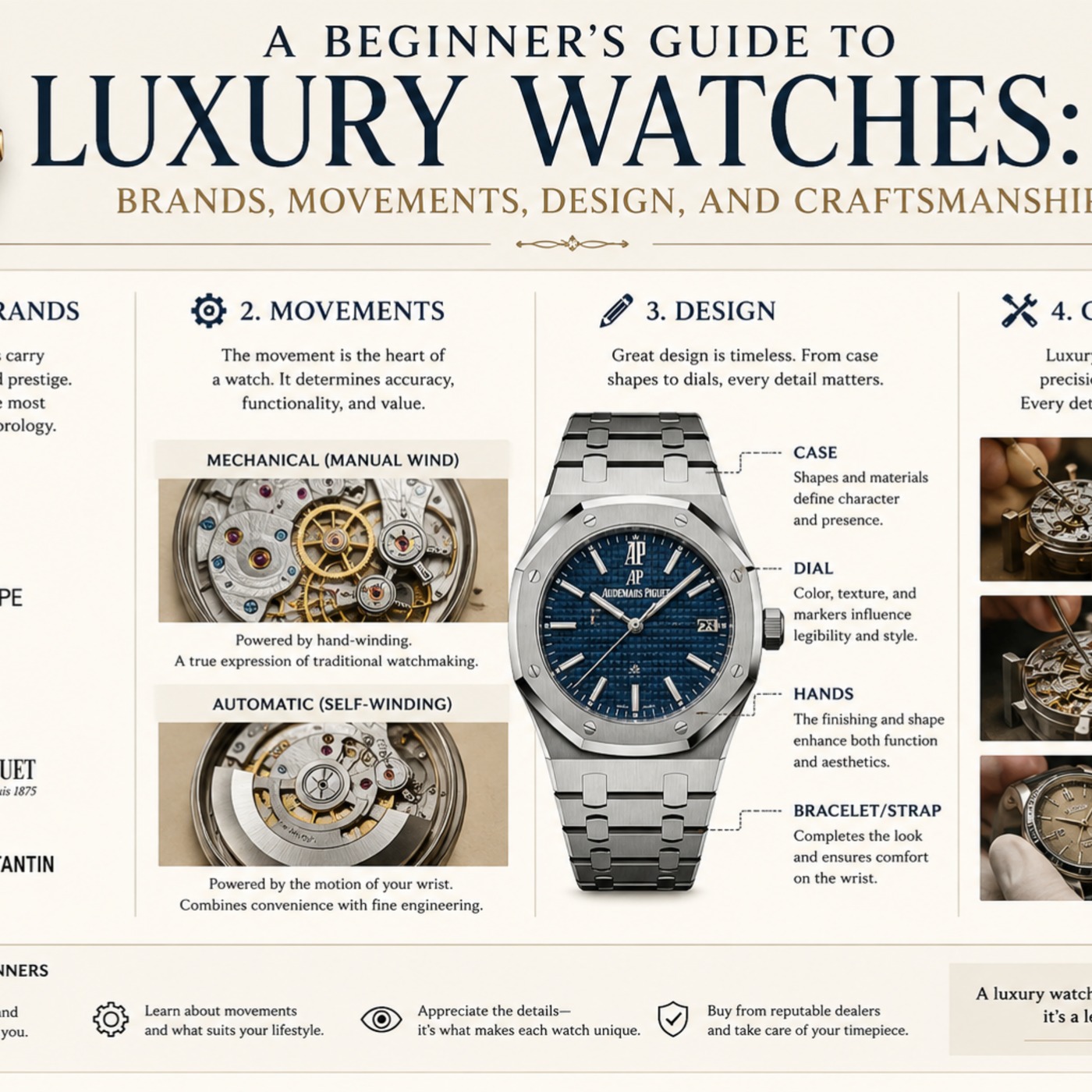
Brands, Movements, Design, and Craftsmanship
0m | Aug 28, 2026Getting interested in luxury watches can feel a little overwhelming at first. There are hundreds of brands, thousands of models, and an entire vocabulary of technical terms to learn. Words such as automatic, chronograph, GMT, power reserve, tourbillon, sapphire crystal, and perpetual calendar appear everywhere.
Fortunately, you do not need to learn everything at once. The best way to enter horology is to understand a few fundamental ideas and then gradually develop your own taste.
After spending time studying watches, one thing becomes clear: a great timepiece is rarely defined by one specification. Its appeal usually comes from the combination of design, engineering, history, craftsmanship, comfort, and personality.
Begin With the Purpose of the Watch
Before thinking about brands, consider what you expect from your watch.
Someone who wants an everyday watch may value durability, legibility, and versatility. A frequent traveler might prefer a GMT function that makes it easier to track another time zone. A motorsport enthusiast may naturally gravitate toward a chronograph.
Divers have different priorities. Water resistance, luminous markers, a rotating bezel, and strong case construction become much more important.
Dress watches occupy another category. Their appeal often comes from thin cases, restrained dials, elegant proportions, and the ability to disappear comfortably beneath a shirt cuff.
A useful rule for beginners: choose the function first, the design second, and the brand third. This approach keeps the decision focused on the watch rather than marketing alone.
Understanding Mechanical Movements
The movement is the engine of a mechanical watch. It contains the components responsible for storing, transmitting, and regulating energy.
Automatic Movements
An automatic movement uses a rotor that moves as the wearer moves their wrist. The rotor transfers energy to the mainspring, allowing the watch to continue running when it is worn regularly.
Many collectors enjoy automatic movements because they provide mechanical sophistication while remaining convenient for everyday use.
Manual-Wind Movements
Manual-wind movements require the wearer to wind the crown periodically. Some enthusiasts particularly enjoy this ritual because it creates a more direct connection with the mechanical system.
Quartz Movements
Quartz watches use electronic regulation and are known for accuracy and convenience. There is no reason for a beginner to dismiss quartz simply because mechanical watches receive more attention from collectors.
The right movement depends on what you want from ownership.
Learn the Difference Between Watch Styles
Understanding categories makes it much easier to navigate the market.
- Dive watches: Built around water resistance, legibility, and timing functionality.
- Chronographs: Designed to measure elapsed time using additional pushers and sub-dials.
- GMT watches: Designed to display an additional time zone.
- Dress watches: Focused on elegance, thinness, and restrained proportions.
- Field watches: Generally emphasize legibility, simplicity, and practical construction.
- Luxury sports watches: Combine robust construction with refined finishing and distinctive design.
These categories are not strict boxes. Modern watches frequently combine characteristics from several styles, which is part of what makes contemporary watch design so interesting.
Why Case Proportion Matters
Beginners often focus on case diameter, but experienced collectors know that proportion is more complicated.
Case thickness, lug-to-lug distance, bezel width, dial opening, and bracelet construction all affect how a watch appears and feels on the wrist.
Two watches with identical diameters can have completely different wrist presence. One may have short lugs and a compact profile, while another may use long lugs and a thick case.
Whenever possible, try a watch on before buying it. Look at it from above and from the side. Move your wrist naturally and pay attention to how the bracelet or strap sits against your skin.
Comfort is not a minor detail. If you plan to wear a watch frequently, it may ultimately matter more than a specification that looked impressive on a product page.
Explore the World of Complications
A complication is a mechanical function beyond basic timekeeping. Some are practical, while others demonstrate the technical capabilities of a watchmaker.
Date Functions
The date display is one of the most familiar complications. More advanced calendar mechanisms can account for differences between months.
Chronographs
A chronograph allows the wearer to measure elapsed time. The additional sub-dials also create much of the visual identity associated with racing-inspired watches.
Perpetual Calendars
A perpetual calendar is significantly more complex because the mechanism is designed to account for different month lengths and leap years.
Minute Repeaters
Minute repeaters represent one of the most fascinating traditional complications. They use mechanical mechanisms to sound the time when activated.
Beginners do not need to purchase a complicated watch. Understanding what these mechanisms accomplish is already an excellent introduction to advanced horology.
Materials Change the Character of a Watch
Material selection affects appearance, weight, durability, and even the way a watch feels during everyday wear.
Stainless steel is popular because it offers durability and versatility. Gold provides a warmer, heavier presence, while titanium can provide strength with lower weight.
Ceramic is frequently used for bezels because of its hardness and resistance to scratches. Sapphire crystal is also common because it offers excellent clarity and strong resistance to everyday scratching.
When comparing watches, do not simply ask which material sounds more luxurious. Consider how the material changes the practical ownership experience.
Look Closely at Finishing
Finishing is one of the subjects that becomes increasingly interesting as your knowledge grows.
A watch case may combine polished and brushed surfaces. Polished areas reflect light strongly, while brushed surfaces create a more restrained texture.
Mechanical movements can receive even more detailed treatment. Beveled edges, polished components, decorative patterns, engraving, and carefully executed transitions can turn functional parts into miniature examples of craftsmanship.
You do not need a loupe immediately. Start by looking carefully at watches under natural and artificial light. Over time, you will become better at noticing differences in execution.
Research the Brand's History
A watch becomes much more interesting when you understand why it was designed the way it was.
Rolex is an excellent example of continuity and practical design. TAG Heuer has a strong connection with chronographs and motorsport. Hublot is associated with contemporary material combinations. Patek Philippe is closely linked with traditional haute horlogerie and complicated movements.
Other brands offer their own perspectives. Bell & Ross explores instrument-inspired aesthetics, Franck Muller is known for expressive case shapes and complications, while Richard Mille has pushed mechanical watchmaking toward highly technical materials and engineering concepts.
Studying these different approaches helps beginners understand that luxury watchmaking does not have one universal design philosophy.
Use Reliable Sources
The internet provides an enormous amount of watch information, but not all of it is equally reliable. Social-media posts can be useful for discovery, while specialist publications can provide historical context and technical discussion.
For industry-level information, official organizations can provide a useful alternative to anonymous forum discussions and promotional material.
The Federation of the Swiss Watch Industry provides Swiss watch industry resources that can help readers explore published information about the Swiss watch sector and its market data.
When researching a particular watch, it is also sensible to compare manufacturer information with independent sources and, where appropriate, professional advice.
Think About Authenticity and Provenance
Authenticity is essential when purchasing an expensive timepiece. A beautiful photograph or attractive price does not prove that a watch is genuine.
Beginners should learn the basic reference information for the watch they are considering. Examine documentation, service records, condition, and provenance where available.
For valuable pre-owned watches, professional inspection can be worthwhile. An experienced watchmaker or qualified specialist may identify details that are difficult for a newcomer to recognize.
Responsible buying is not about finding the cheapest possible offer. It is about understanding what you are purchasing and being confident about its history.
Do Not Let Trends Choose for You
One of the biggest changes in watch collecting is the influence of social media. A watch can suddenly become extremely visible because of celebrity appearances, online communities, or viral photographs.
Popularity can introduce you to interesting watches, but it should not determine your entire collection.
Ask yourself whether you would still appreciate a particular watch if nobody were posting about it. If the answer is yes, there is a good chance that your interest is based on genuine appreciation.
Personal taste develops slowly. Give yourself permission to change your mind.
Build a Collection Slowly
There is no requirement to own several watches immediately. In fact, buying slowly is often one of the best ways to become a more knowledgeable collector.
Wear a watch for a few weeks. Notice whether you enjoy the dimensions, dial, bracelet, movement, and overall personality.
Then compare that experience with the watches you considered but did not buy.
Over time, patterns will emerge. You may discover that you prefer smaller cases, simple dials, manual movements, chronographs, or highly technical sports watches.
Those discoveries are more valuable than following a predetermined collecting strategy.
Common Beginner Mistakes
- Buying purely because of popularity: Market attention does not guarantee personal satisfaction.
- Ignoring comfort: A watch should work on your wrist, not only in photographs.
- Focusing only on specifications: Bigger numbers do not automatically create a better watch.
- Rushing the purchase: Patience gives you time to discover better alternatives.
- Ignoring maintenance: Mechanical watches require long-term care and professional servicing.
- Trusting one source: Important purchasing decisions deserve independent verification.
Final Thoughts
Luxury watch collecting becomes much more rewarding when you approach it as a process of discovery. You do not need to know every reference number or complication from the beginning.
Start with the fundamentals. Understand the difference between automatic, manual, and quartz movements. Learn how case proportions affect comfort. Explore the purpose of complications. Compare materials, study finishing, and investigate the history behind different watch designs.
Most importantly, develop your own judgment.
The best watch for one collector may be completely wrong for another. One person may value understated elegance, another may prefer a technical chronograph, while someone else may be fascinated by an intricate perpetual calendar.
That diversity is what makes horology so enjoyable. There is room for traditional craftsmanship, professional instruments, modern materials, experimental engineering, and timeless design.
As your knowledge grows, you will begin to notice details that once seemed insignificant. A subtle change in case finishing, the architecture of a movement, the relationship between a dial and its hands, or the way a bracelet articulates around the wrist can suddenly become fascinating.
At that point, you are no longer simply shopping for a watch. You are learning to appreciate watchmaking.
And that is ultimately the most satisfying part of becoming a collector: understanding the object well enough to know not only what you like, but why you like it.